

MrSID: Guide to High-Performance Geospatial Image Compression

Updated: Apr 23
In the world of big data and high-resolution satellite imaging, it is increasingly essential to deliver and manage geospatial datasets effectively. MrSID is a high-performance product for image compression in geospatial applications. In this guide, we will look at the technologies behind MrSID, its advantages, and how to actually apply it in GIS, remote sensing, and other geospatial fields.

What Is MrSID?
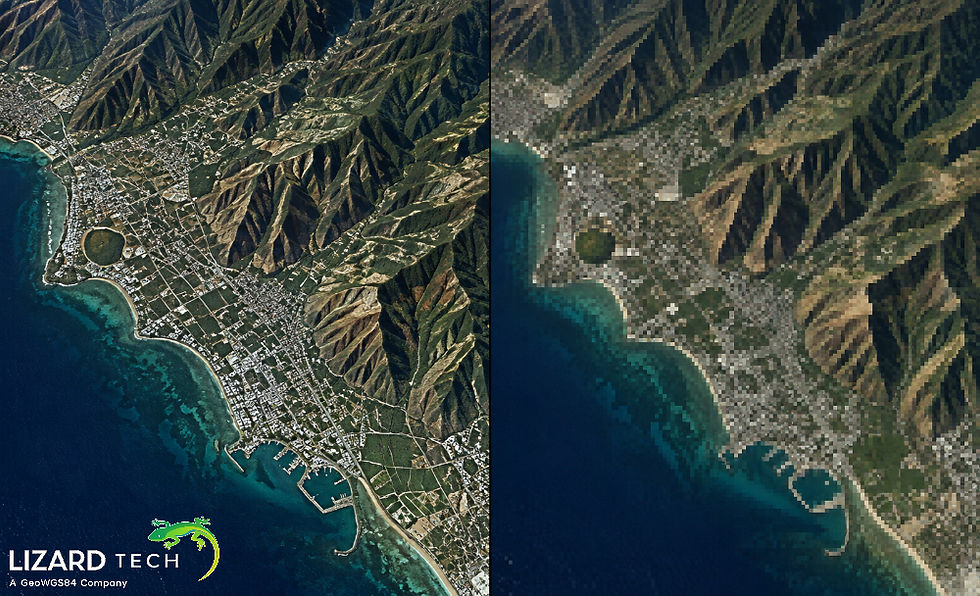
MrSID is a proprietary raster image format from LizardTech, created specifically to compress large geospatial imagery. While other raster formats, such as TIFF or JPEG, may compress the file size, they will sacrifice spatial resolution or image quality. MrSID is designed for large raster datasets such as aerial photographs, satellite imagery, and scanned imagery of maps.
Key Features of MrSID:
Multi-resolutions: Allows information to seamlessly scale from an overview to a detail phase when viewing.
Lossless and lossy compression: Maintain file efficiency based on the project's needs.
Random access: Allows users to access the specific portion of the image without fully decompressing the entire file, which can stymie application times.
Space efficient: On a compressed basis, MrSID files can achieve about a 20:1 compression ratio over non-compressed GeoTIFFs.
Compatibility with GIS software: We have demonstrated that there are other leading GIS packages, such as ArcGIS, QGIS, and Global Mapper, which provide compatibility.
How MrSID Compression Works
MrSID utilizes wavelet-based compression methods rather than JPEG's traditional block-based compression. To explain technically:
Wavelet Transformations:
An image is broken down to obtain a set of wavelet coefficients that represent low-frequency (approximation) and high-frequency (detail) information about the image.
Quantization:
The coefficients will then be quantized for the limited precision needed, which can be defined to allow lossless and lossy methods to be possible.
Entropy Encoding:
The quantized coefficients are then entropy encoded (like arithmetic encoding), resulting in further compression over the coefficient-based data.
Multi-resolution Pyramids:
Finally, MrSID stores these and builds a hierarchy (pyramid) so that a user can access different levels of detail at will. This allows for fast rendering of even datasets that are larger than a typical desktop environment can handle.
Advantages of MrSID for Geospatial Applications
Efficiency in Storing Data:
Examples of geospatial images, such as high-resolution satellite imagery, can easily exceed tens of gigabytes per scene. MrSID compresses such an image by about 95% making the storage costs reasonable while still having usable detail for analysis.
Faster Sharing of Data:
Massive geospatial datasets are often distributed on networks to provide cloud GIS services, mobile applications, or collaborative projects. Slower speed of transferring massive datasets is possible with the compressed format of MrSIDs that eases the immediate streaming, making real-time GIS applications easier.
Efficient Map Representation
MrSID adds support for multi-resolution access for GIS platforms and allows users to only render the image needed based on the current zoom level. This provides lower memory overhead and improved performance in viewing maps interactively for mapping applications.
Compatible with Analytical Workflows
MrSID files are compatible with common geospatial libraries and APIs, and so can be directly used in raster analysis, terrain modeling, and georeferencing.
Comparing MrSID with Other Geospatial Formats
Feature | MrSID | GeoTIFF | JPEG2000 |
Compression Ratio | High (10:1+) | Low (1:1 or 2:1) | Medium (10:1) |
Lossless Support | Yes | Yes | Yes |
Multi-resolution Access | Yes | No | Yes |
Random Tile Access | Yes | No | Yes |
GIS Software Support | High | High | Medium |
Best Practices for MrSID Compression
Identify Compression Method:
When preserving data or performing an elaborate analysis, use lossless compression. For web display or previews, use lossy compression.
Consider Tile Size:
Choosing tile sizes should be a balance between space savings and reading performance. Smaller tiles will increase reading speed but increase some overhead.
Use Appropriate Software:
You can use programs like GeoExpress to manage batch processing and convert large datasets to MrSID form.
Keep Metadata Intact:
Preserving geospatial reference data during a compression step (coordinate system, projection, etc.) will save errors later on.
MrSID remains a mainstay for high-speed and space-efficient compression of geospatial images. Its unique wavelet, multi-resolution design has made it unmatched for storing, accessing, and sharing high-level imagery in large quantities. Use of MrSID will considerably improve workflow efficiency and decision-making abilities for GIS professionals, city planners, environmental scientists, and remote sensing scientists.
Understanding how MrSID compression works and being aware of best practices can help organizations design, build, and implement data workflows with an added emphasis on speed and quality.
For more information or any questions regarding MrSID, please don't hesitate to contact us at
Email: info@geowgs84.com
USA (HQ): (720) 702–4849
(A GeoWGS84 Corp Company)


Comments