

Image Compression Explained: How It Works and Why It Matters

The modern era has changed how we look at things. You’ll find images all around you, whether it’s on the Internet, an aerial photograph taken by a drone, or through other means such as satellites. As the resolution of pictures rises, so does the demand for efficient storage systems that can hold, send, and manage large amounts of data. Image compression takes on an important function as we solve these problems.
This guide provides insight into how image compression works, the differences between lossy and lossless methods of compressing images, and why newer formats like MrSID are important to working with both geospatial and very large-image workflows.

What Is Image Compression?
Image Compression Is the Process of Decreasing the Size Of A Digital Image File While Trying To Preserve As Much Of The Original Image Quality And Information As Possible.
The Goal Is To Achieve The Following:
Reduce Storage Space Needed To Store An Image
Speed Up Image Transfer Time
Increase Application Performance
Optimize Web And Cloud Delivery
If Images Were Not Compressed, Extremely High Resolution Digital Images (Especially Geospatial Image Files - Rasters) Would Be In Excess Of Gigabytes Or Terabytes; Therefore, Their Size Would Diagnose Operational Issues Within All Aspects Of The Organization (e.g., infrastructure, applications, and network connectivity).

How Image Compression Works
At a technical level, image compression reduces redundancy in image data. Images contain patterns, repeated colors, and spatial correlations that compression algorithms can exploit.
Compression algorithms typically perform three main steps:
Transformation
Many advanced compression methods convert image data into a different mathematical representation. For example:
JPEG uses the Discrete Cosine Transform (DCT)
Wavelet-based formats use multi-resolution analysis.
Wavelet transforms are particularly powerful for large images because they support progressive resolution decoding.
Quantization (Lossy Compression Only)
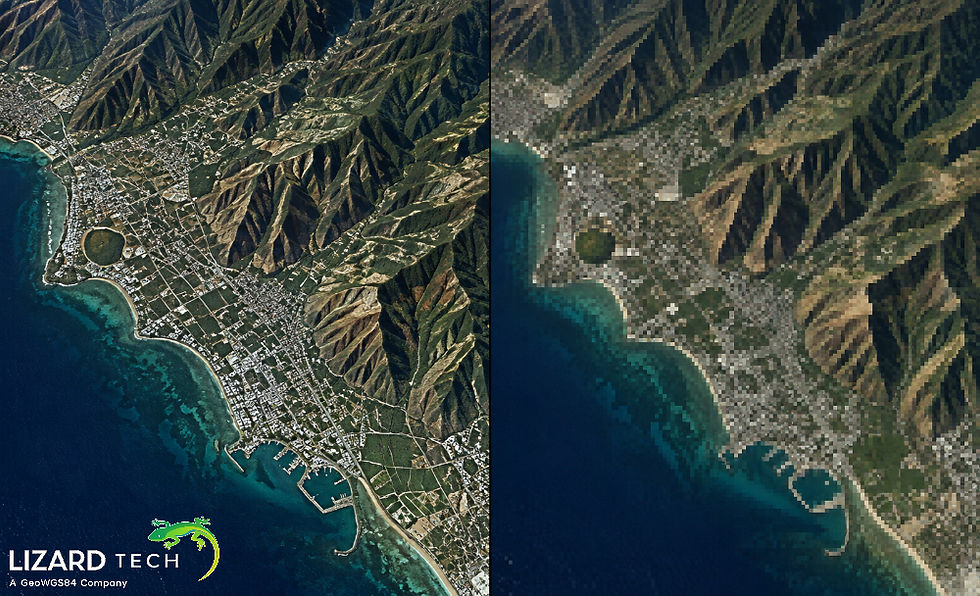
In lossy compression, less visually significant data is reduced or removed. This step dramatically decreases file size but may introduce artifacts if compression is too aggressive.
Encoding
The remaining data is encoded efficiently using techniques like:
Run-length encoding (RLE)
Huffman coding
Arithmetic coding
This step eliminates statistical redundancy to shrink the file further.
Understanding the difference between lossy and lossless compression is crucial when choosing a format.
Lossless Compression
No data is permanently removed.
The original image can be perfectly reconstructed.
Larger file sizes compared to lossy
Common examples:
PNG
TIFF
Lossless compression is ideal for medical imaging, technical drawings, and archival workflows.
Lossy Compression
Permanently removes some data.
Much smaller file sizes
Slight quality degradation possible
Common example:
JPEG
Lossy compression works well for web images and photography, where small size is more important than perfect reconstruction.
Why Large Images Are Different
For smaller images, traditional compression formats tend to perform well, while larger geospatial images, such as satellite and aerial photography, have unique problems that need to be addressed, including:
Large pixel dimensions (many times larger than equally dimensioned images)
Multi-band raster data
High bit depth
The need to be able to "zoom" and "pan" quickly
Stream images over multiple networks
Traditional formats can require that the full image be loaded into memory; therefore, using traditional compression methods can be inefficient when dealing with large datasets.
Wavelet-based multi-resolution formats are the solution to the previous problems.
The Power of Wavelet Compression and MrSID
The MrSID (Multi-resolution Seamless Image Database) is an image compression format developed by LizardTech that uses wavelets to compress a large raster image in a way that supports geospatial workflows. The ability of MrSID technology to provide:
File sizes that are orders of magnitude smaller than the original file size
Rapid display of an image at different zoom levels
High-capacity storage of large volumes of images
Progressive decoding that allows a lower resolution version of an image to be viewed before loading the higher resolution
An efficient method of streaming images over the Internet
Unlike conventional image formats, MrSID employs a multi-resolution pyramid to store images. Allowing for only the resolution level needed to be viewed and/or analyzed without the need to load the entire dataset.
The result for GIS professionals, remote sensing professionals, and governmental agencies is a significant increase in performance and scalability.
Why Image Compression Matters
Reduced Storage Costs
High-resolution imagery consumes enormous storage resources. Efficient compression reduces infrastructure costs in on-premises and cloud environments.
Faster Data Transmission
Compressed files transmit faster over networks. This is critical for:
Web mapping services
Cloud-based GIS platforms
Remote collaboration
Satellite imagery distribution
Improved Application Performance
Applications that support advanced formats like MrSID can render large images quickly without overwhelming memory or bandwidth.
Scalable Geospatial Workflows
From statewide aerial surveys to global satellite datasets, compression enables practical, scalable deployment of large imagery archives.
The Future of Image Compression
As sensor resolutions increase and AI-driven image analysis expands, image datasets will continue to grow exponentially. Efficient compression technologies will remain foundational to:
Geospatial intelligence
Smart cities
Environmental monitoring
Defense and security systems
Autonomous systems
Wavelet-based technologies like MrSID continue to demonstrate how intelligent compression design can support both performance and image fidelity at scale.
Image compression is far more than shrinking file sizes—it’s about enabling performance, scalability, and accessibility in a world dominated by high-resolution imagery.
For organizations working with massive raster datasets, choosing the right compression technology can dramatically reduce storage costs, accelerate workflows, and improve user experience.
If your workflows involve large geospatial images, wavelet-based solutions like MrSID provide a powerful and proven approach to managing imagery efficiently.
For more information or any questions regarding the LizardTech suite of products, please don't hesitate to contact us at:
Email: info@geowgs84.com
USA (HQ): (720) 702–4849
(A GeoWGS84 Corp Company)


Comments