

What Is GeoExpress and How Does It Work?

Updated: Apr 22
To remain competitive in the fast-paced world of spatial data, geospatial workflow systems must have robust technologies for compressing and manipulating the massive raster datasets that are being created today. GeoExpress was developed by LizardTech and is now owned by GeoWGS84 Corp., recognized as one of the most powerful geospatial compression and manipulation applications available for users of very high-resolution imagery, such as MrSID and JPEG 2000 formats, among others.
If you are responsible for managing the very large volume of images produced by satellite systems, as well as those from aerial scanning or LiDAR systems, then knowing how GeoExpress works can give you an incredible advantage in the structure of your data processing systems.
What is GeoExpress?
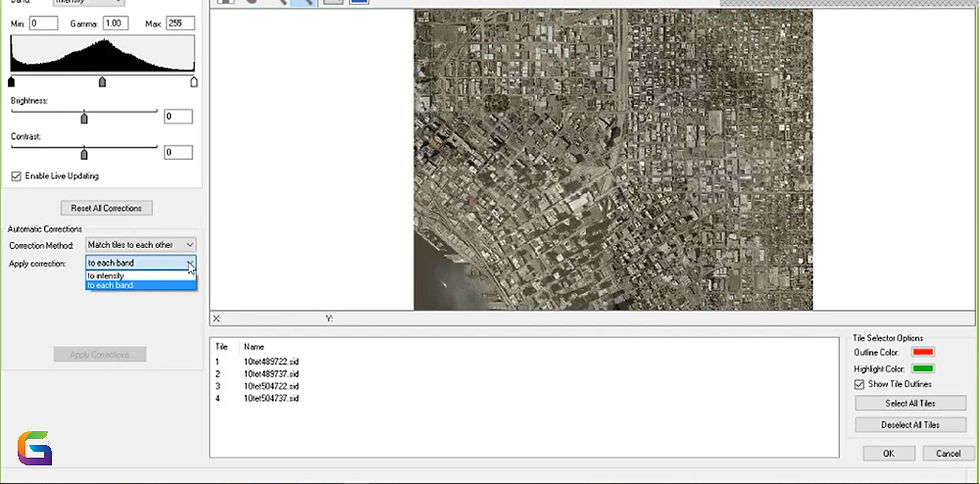
GeoExpress is a powerful geospatial image compression and processing application designed to give organizations that produce a large volume of raster data the ability to efficiently store, manipulate, deliver, and access that data, with minimal loss of quality. The application supports many advanced features, including advanced encoding, mosaicking, color balancing, reprojection, tiling, and format conversion. GeoExpress will also play a key role in the creation of GIS applications and their integration into systems of record for organizations that rely on GIS for their operations.
How is GeoExpress typically used?
To compress ultra-large imagery (multi-terabyte archives)
The primary reason for the popularity of GeoExpress is the ability to reduce a file's size up to 95%, while retaining a visually lossless quality; thus, organizations storing and serving petabyte-scale geospatial archives will find GeoExpress an invaluable tool for their data storage, processing, and delivery operations.
The Technology Behind GeoExpress
The technology behind GeoExpress combines high-performance encoding technology with MrSID Generation Four (MG4) and JPEG2000 compression techniques to provide a robust, efficient way for creating raster images with geo-referencing. The overall workflow consists of five basic components:
Raster Compression Engine
The core of GeoExpress is an innovative, proprietary compression system based on wavelet technology.
How wavelet compression works
As part of the process of creating raster images using GeoExpress, the source image will first be decomposed into multiple wavelet layers.
Each of these layers contains a different spatial frequency (fine vs. broad) of the source image.
The geoexpress software will then be used to selectively compress out the redundant and/or low-impact data while retaining the high-value/signal information.
This ensures that the output raster image will remain clear at even higher compression ratios.
Modes of Compression
Compression types offered by GeoExpress consist of:
Lossless Compression - where all pixel values are preserved exactly
Visually Lossless Compression - where human vision optimizes the amount of visually lossless data remaining with the least amount of visible compression artifacts
Lossy Compression - the maximum amount of compression possible while retaining an acceptable degree of visual integrity
In addition, the raster compression engine allows for rapid decoding and streaming of images for web GIS applications and tiled basemap servers.
Multi-Resolution Storage (MRSID Technology)
One of the reasons GeoExpress is so effective for large imagery is its pyramidal storage structure.
The Importance of Multi-Resolution
Multi-resolution storage stores multiple resolution levels within one file.
GIS programs can quickly render the best resolution for the zoom level.
Using a multi-resolution file, there is no need to create a separate overview (pyramid) file.
Utilizing this architecture has reduced the level of Disk I/O, the amount of bandwidth consumed, and the load on servers.
Intelligent Mosaicking and Reprojecting Capability of GeoExpress.
GeoExpress has advanced preprocessing functions that make managing large data sets and images easier.
Mosaicking Capabilities
Seamless blending at the edges
Automatic colour balance
Feather and seamline optimization.
Ability to handle very large input image data sets.
Reprojection Capabilities
Reproject images on-the-fly from hundreds, if not thousands, of different coordinate systems.
Support custom EPSG codes.
Built-in transforms for NAD 83, WGS 84, UTM, and State Plane Coordinate Systems.
Advanced Tiling and Image Partitioning
GeoExpress handles extremely large rasters by breaking them into optimized, server-ready components.
Tile-Based Output Options
Generate uniform tile grids (e.g., 256×256 or 512×512)
Align tiles to OGC-compliant schemas.
Support for web services (WMTS, XYZ, TMS)
Ideal for building scalable cloud-hosted basemaps
This feature allows massive imagery to load quickly in web maps, even at global scales.
Batch Processing and Automation
GeoExpress supports scripting and large-scale automation.
Automation Features
Command-line interface (CLI)
Batch compression queues
Integration with Python or shell scripting
Scheduling for nightly or incremental updates
Data administrators can implement highly efficient, repeatable workflows across entire enterprises.
GeoExpress has many advantages:
Footprint Decrease of >95%
Choose GeoExpress to save nearly 95% of your storage capacity without degrading the quality of your data.
Speed of Display and/or Streaming
Optimized pyramids and Wavelet compression allow for relatively fast data display when integrated with GIS applications.
Scalable to Enterprise Levels
GeoExpress is an ideal solution for government, utility, defense, and imagery providers.
Direct Compatibility with the Most Common GIS Applications
GeoExpress automatically connects with GIS applications such as ArcGIS, QGIS, MapServer, GeoServer, and many others.
MrSID (MG4) Support at the Top of the Industry
GeoExpress supports enhanced workflows with improved support for both multispectral and hyperspectral data.
Who Uses GeoExpress?
Professionals working in the area of high-resolution and/or high-volume imagery require access to GeoExpress. These include:
Photogrammetrists
Remote sensing analysts
GIS Technicians and Cartographers
Surveyors
Federal & state governmental agencies
Utility and Infrastructure Mapping Teams
If your workflows involve terabyte-scale raster archives, GeoExpress can dramatically increase efficiency.
As a leading provider of technical solutions for geospatial imagery through the latest technology available, GeoExpress has continued as one of the most technologically advanced tools available. By using wavelet-based encoding, multi-resolution storage capabilities, intelligent mosaicking capabilities, and enterprise-grade automation capabilities, GeoExpress enables organizations to handle large volumes of raster data using a combination of accuracy, speed, and scalability.
In addition to using GeoExpress for optimizing imagery for cloud hosting and preparing basemaps, GeoExpress can be used to streamline an organization's enterprise GIS workflow. GeoExpress is proven to provide organizations with the performance and reliable service that these organizations require.
For more information or any questions regarding the LizardTech suite of products, please don't hesitate to contact us at:
Email: info@geowgs84.com
USA (HQ): (720) 702–4849
(A GeoWGS84 Corp Company)


Comments