

Reducing Data Bloat: Compressing Satellite Imagery

Updated: Aug 14
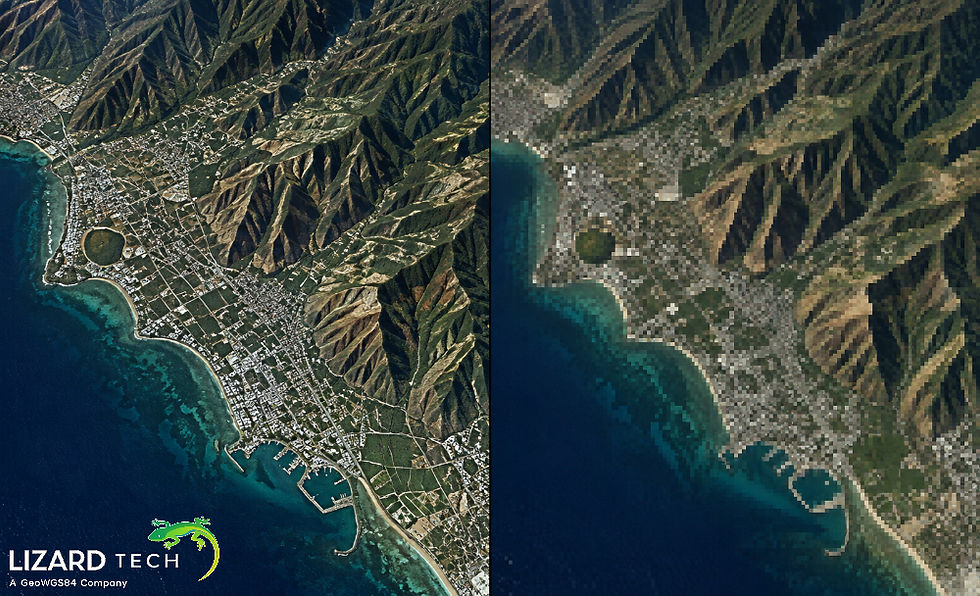
Industries ranging from defense to environmental monitoring; urban planning; agriculture; disaster response have applied high-resolution satellite images for many years. As sensor technology continues to advance, satellites will provide images of unprecedented spatial, spectral and temporal resolutions. This advancement creates a greater opportunity to analyze large amounts of data more deeply. However, as this data grows in size, these same organizations face a challenge called data bloat.
Management of large image datasets at scale now requires an organization's ability to perform data compression that will allow the organization to store, transmit, process, analyze and create value from these types of images while still maintaining the integrity or quality of the data created from these images.

The Data Explosion in Satellite Imagery
Terabyte data sets are produced every day by modern satellites used for Earth observation. Higher resolution means:
Increased pixel size
Increased bit depth
Increased number of spectral bands
Increased frequency with which images are revisited
Based on a single high-resolution image that, when uncompressed can exceed several gigabytes and the growth of this image based on time series, total global coverage and/or total enterprise archives, the demand for both storage and bandwidth is increasing exponentially.
Without an effective compression strategy, organizations face:
Escalating storage costs
Slower data transfer and ingestion
Reduced accessibility for analysts and end users
Performance bottlenecks in GIS and remote sensing workflows
Why Compression Is Not Just About Saving Space
Although most people think of compression as a way to make files smaller, its affects on satellite images are much wider than that.
Faster Access to Data and Streaming
Because compressed images allow access to just the parts of the image needed for analysis or visualization, instead of downloading the entire dataset, users are now able to stream particular areas or levels of resolution that significantly improve performance in both desktop GIS and web mapping applications.
Efficient Storage and Archiving
Lossless or visually lossless compression reduces significantly the amount of space required for long-term storage and does not lose critical information in the process. This is especially true for organisations that must maintain and archive historical or regulatory data sets that need to be preserved for years or decades.
Optimised Workflows in the Cloud and Network
Compression has an immediate impact on the cost of cloud storage and egress fees as well as network latency, as satellite image data is becoming increasingly available through hybrid and cloud-based infrastructures. Smaller, more efficient files reduce (the cost of) operational overhead, enabling scalable distribution across teams and platforms.
Preserving Analytical Integrity
Advanced compression algorithms are designed to maintain both radiometric accuracy and spatial fidelity, enabling the compressed image to continue to be suitable for scientific analysis, machine learning, and decision-making workflows.
The Role of Advanced Image Compression Formats
Not all compression methods are created equal. Generic image formats often fall short when handling extremely large geospatial datasets. This is where specialized geospatial compression technologies become essential.
MrSID: Purpose-Built for Geospatial Imagery
MrSID or Multi Resolution Seamless Image Data Base, is created for storing raster data sets, including photography taken from satellites and aerial views of the ground. MrSID has the following advantages:
Able to use compression ratios of a very high degree with little or no visible degradation.
Has an option for storing images at multiple resolutions, making it easy for users to immediately see all of the images that have been stored at any resolution.
Users can easily select which parts (regions) of the images stored in MrSID to be downloaded.
Capability of performing either lossless (no data loss) or lossy (many will have lost data) processing, based on the needs of the user.
As a result of these advantages, MrSID is especially well suited for managing high-resolution satellite imagery in Enterprise GIS, Defense Applications, and significant Mapping projects.
GeoExpress: Controlling Compression with Precision
To produce high-quality compressed images, it takes more than simply choosing a file format for the image itself; it also takes control over how you compress the images. GeoExpress gives you sophisticated tools for encoding, optimizing, and manipulating MrSID imagery.
Utilizing GeoExpress, organizations are able to:
Adjust compression parameters for individual use cases
Achieve the best possible combination of image quality, file size and performance.
Convert large amount of raw data into usable images that can be distributed
Achieve consistency across large libraries of imagery.
Having this degree of control is very important if the imagery needs to function for both visualization and analytical purposes, across many different workflows.
Compression and the Future of Satellite Data
As the number of satellites in space continues to increase along with the availability of live imagery from those satellites, the amount of data being generated will increase. The need for fast and reliable access to images for new applications such as artificial intelligence-based (AI) image analysis, digital twin technology and real-time monitoring will also lead to increases in the amount of data being generated.
Compression will remain a fundamental technology supporting:
Scalable geospatial systems built using cloud-native technology
Rapid delivery of critical images during times of crisis
Affordable long-term management of data
Improved collaboration between different communities and technologies
Good quality imagery from the high-resolution satellite will only be as useful as it can be easily managed and made available for use. The use of compression is not a just a means of optimising storage; but instead, it is a critical tactical component of a contemporary geospatial operation.
Technologies such as MrSID, in addition to applications such as GeoExpress, evidence how custom-made compressed image files can not only reduce the amount of data associated with each image, but they can do so without losing the quality of an image, the performance of an image, or the analytical integrity of an image. Consequently, as the volume of imagery continues to rise, those agencies that invest in advanced methods of compression will be positioned to realize the full value of their geospatial data.
For more information or any questions regarding the LizardTech suite of products, please don't hesitate to contact us at:
Email: info@geowgs84.com
USA (HQ): (720) 702–4849
(A GeoWGS84 Corp Company)


Comments