

Behind the Scenes: How MrSID Was Born and Evolved

Updated: Apr 22
The size of geospatial data is significant. Imagery and point cloud data have gone from megabytes of storage to terabytes of storage, which has required a way to store, transmit, and visualize these large files without compromising quality or performance. This created the need for MrSID® (Multiresolution Seamless Image Database); a new compression and streaming technology developed by LizardTech.
In this behind-the-scenes look, we'll see how MrSID was created, what technical issues it solved, and how it became one of the main technologies for geospatial imagery and LiDAR data.

The Problem That Sparked MrSID
During the 1990's Government Agencies, mapping companies and GIS professionals were rapidly adopting high-resolution raster imagery; Satellite and Aerial imaging had developed more rapidly than the availability of storage and bandwidth for desktop hardware.
Some primary issues with these developments were the following:
Extremely large raster image file sizes
Slow data transfer rates over limited networks
Inability to efficiently visualize or analyze full resolutions of imagery
Redundant storage for multiple levels of resolution of images.
Traditional image formats do not accommodate geospatial accuracy or scale requirements. The industry required a compressed format of lossless quality that could be quickly accessed regardless of which portion, and what resolution, was being viewed.
The Birth of MrSID Technology
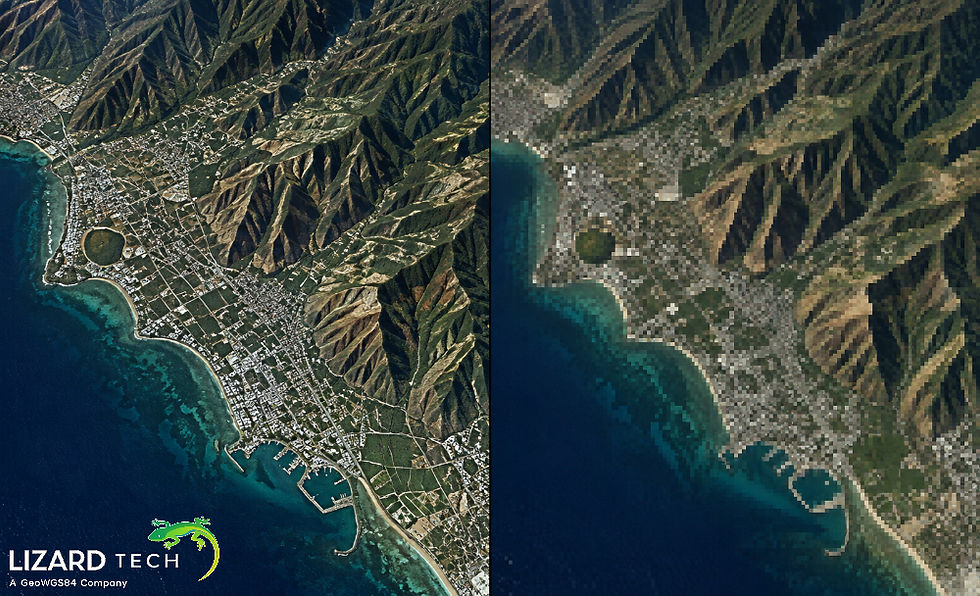
The problem of managing pixel files was solved by LizardTech's MrSID through the use of wavelet-based image compression combined with a multiresolution architecture. Instead of maintaining separate pyramids for imagery, MrSID's single file can be read at multiple resolutions by encoding the imagery once.
The primary goal for MrSID was to:
Achieve an overall compression ratio of between 10:1 and 50:1 (or greater) on geospatial imagery.
Retain spatial integrity and visual fidelity.
Provide for fast access to imagery using streaming technology and non-contiguous access requirements.
Support accurate and complete georeferencing features and metadata.
The use of MrSID substantially reduced the cost to store large datasets and allowed the distribution of these data across a single, standard network link.
Multiresolution and Streaming: A Technical Breakthrough
The multiresolution architecture of MrSID is one of its most significant innovations. It allows users to access image data while zooming, panning, or querying (i.e., accessing image data without having to load the entire set into memory).
Technical advantages of multiresolution architecture include:
Region-of-interest decoding: The ability to access only the pixels required for your particular region of interest.
Progressive display: The ability to immediately display low-resolution data while higher-resolution data continues to load after you're done with the lower-resolution data.
Efficient caching: The performance can be optimised for use in GIS and remote sensing applications.
These capabilities make MrSID particularly useful for web-based mapping, enterprise GIS systems, and field operations where bandwidth is limited.
Expanding Beyond Imagery: MrSID for LiDAR
With LiDAR point cloud data becoming vital in preparing 3D maps and modeling land forms, LizardTech extended their MrSID technology to address yet another challenge – how to compress LiDAR files efficiently.
MrSID (MG4) LiDAR compresses large point cloud datasets using the same features — scalability, random access and high compression.
Examples of this include:
Cutting down on LAS file size by a large factor
Allowing access to small portions of point clouds quickly
Preserving the attributes and accuracy of point data
Easily fitting into the existing workflows used to process LiDAR files
This advancement has positioned MrSID as the only product solution in use today for both raster and 3D geospatial data.
Industry Adoption and Standards Support
Over the years, MrSID has gained significant support in GIS, Remote Sensing and Photogrammetry, and many other application areas using GIS, Remote Sensing and Photogrammetry software. LizardTech collaborated with many industry partners to ensure compatibility, performance and long-term reliability.
MrSID has proven to be successful based on:
Maintained backwards compatibility with older versions
High-quality SDK’s available for developers
Support for geospatial standards and metadata
Commitment to maintaining data integrity over the long term
MrSID Today and Beyond
Today, MrSID continues to play a vital role in managing large geospatial datasets. While data volumes and platforms have evolved—cloud storage, web services, and AI-driven analytics—the core principles behind MrSID remain just as relevant.
LizardTech continues to innovate in:
High-performance geospatial compression
Scalable data delivery
Tools that reduce infrastructure costs while increasing accessibility
MrSID’s evolution reflects a broader truth in geospatial technology: smart data management is just as important as data collection.
MrSID has transformed the way we store, share and access geospatial data from its inception as a solution to large raster images to its evolution into LiDAR and enterprise size workflows. MrSID has benefited from many years of engineering effort and development to create an efficient and effective method of handling large geospatial data.
If you would like more information about MrSID technology or LizardTech’s geospatial solutions, please check out the lizardtech.com website for additional resources.
For more information or any questions regarding the LizardTech suite of products, please don't hesitate to contact us at:
Email: info@geowgs84.com
USA (HQ): (720) 702–4849
(A GeoWGS84 Corp Company)


Comments