

Why Efficient Geospatial Data Matters for Smart Cities

Updated: Apr 22
Smart cities utilize copious amounts of data. It doesn't matter whether you need information on transportation planning, public safety, utilities, environmental monitoring, or urban development. The backbone of a city is comprised of geospatial data. Not only do smart cities rely on geospatial data for their growth and future expansion, but as Smart Cities become more technologically advanced, the volume, resolution, and complexity of the geospatial images City Hall uses are growing exponentially. Efficient management of geospatial data becomes more than just a desirable characteristic - it is now necessary.
This article discusses why efficient management of geospatial data is so important in Smart Cities and how MrSID® image compression technology enables them to convert large volumes of data into actionable intelligence.

The Role of Geospatial Data in Smart Cities
The city planners, GIS (Geographic Information Systems) professionals, and any other individuals engaged in the construction and management of a geographic area can use geospatial data to determine what is happening when. and how do those systems interact within the city, using a map-based technique to visualize the data, therefore, allowing for improved communication and greater understanding of all areas impacted by urban planning initiatives.
Among the many examples of smart city technology, the following are some common use cases:
Urban Planning and Zoning
Transportation / Traffic Optimization
Infrastructure Asset Management
Disaster Response and Emergency Preparedness
Environmental Monitoring & Sustainable Development Programs
Public Safety / Situational Awareness
One of the main advantages of using high-resolution aerial, satellite, and drone imagery is the level of detail with which you can view the images. However, with this level of detail also comes many challenges in regard to the volume, data, storage, transmission, and performance.
The Challenge: Massive Imagery Data at Scale
Modern image datasets may be terabytes or even petabytes in size. Without effective compression and management, there are multiple challenges to cities, including:
high cost for storing uncompressed or low-compressed images
Poor performance in accessing the data for analysis or decision-making purposes
Limited available bandwidth for departmental and public access/transportation
Bottlenecks in web-based Geographic Information Systems (GIS) and Cloud environments
To be considered smart cities, delays in accessing geospatial information can become a direct factor in response time increases to emergency services, operational cost increases, and loss of potential optimisation opportunities.
Why Efficient Geospatial Data Is Critical
Smart cities utilise efficient geospatial information to improve their performance and accessibility.
Performance and Accessibility
Compressed imagery allows for quicker access to the data by City staff and stakeholders. Imagery that takes a very long time to fully download or view in a desktop GIS application, web mapping, or mobile device will load almost instantly through the use of compressed formats.
Lower Storage and Infrastructure Costs
High-quality compressed imagery results in a significant reduction in overall file size, while maintaining image quality and accuracy during analysis. Smaller file sizes equal smaller storage requirements, and therefore, lower storage costs, for cloud and on-premises Infrastructure.
Large Scale, High Volume Smart City Platform
Every time a Smart City initiative expands, so does the volume of geospatial information that Cities store and process on a GIS or analytics platform. By utilising efficient data formats, Cities can scale their GIS and analytics platforms without losing performance.
Real-Time Workflows
The efficient delivery of imagery allows for the timely delivery of geospatial information for applications, such as emergency response, traffic monitoring, and infrastructure inspection. In addition, efficient imagery will ensure that image data is delivered promptly, which allows for asset lifecycle management to be in sync with operational requirements.
The Importance of Imagery Compression
One of the primary building blocks of an efficient geospatial data management system is the use of imagery compression to reduce file sizes while providing the accuracy and quality required for visualisation and analysis purposes.
Advanced Compression technologies provide:
Lossy and Lossless Compression options
Multi-Resolution access to allow users to easily zoom in on, and Pan Around the imagery as needed
Optimised Streaming of imagery for use in Cloud & Web deployment
Long-Term Archival Stability.
While not all Compression technologies are of equal value, smart cities require tailored solutions for the compressed Geospatial Imagery they need to support their operations.
MrSID®: Proven Compression for Geospatial Imagery
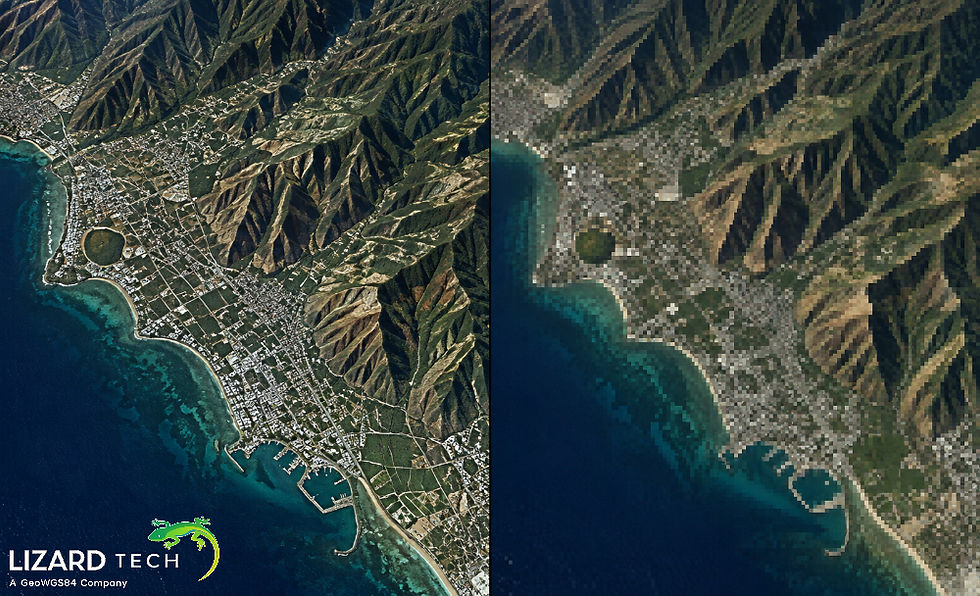
The MrSID® (Multiresolution Seamless Image Database) image format has become a standard for storing large amounts of raster data and has been specifically developed for use with geospatial data.
Some of the key advantages that MrSID provides to smart cities include:
High compression rates offer a significant reduction in image file sizes. a
Excellent visual quality even at a very high compression ratio
Multi-resolution allows images to be displayed quickly, regardless of the size selected.
Efficient streaming is ideal for web delivery and GIS cloud-based services.
Enduring reliability, MrSID continues to be used by both mapping agencies and government organisations throughout the world.
By converting high-resolution aerial, satellite, and drone-based images to the MrSID format, many cities will have the ability to efficiently store, share, and derive analytic products from these vast datasets, all while maintaining a high degree of accuracy and ease of access.
Enabling Smarter Decisions with Better Data
Efficient geospatial data is not just a technical requirement; it is a strategic advantage. When imagery is easy to access, fast to load, and cost-effective to manage, city leaders can focus on insights rather than infrastructure limitations.
With advanced imagery compression technologies like MrSID, smart cities can:
Accelerate planning and development workflows.
Improve collaboration across departments.
Deliver better public-facing mapping services.
Build resilient, data-driven urban environments.
Smart Cities' evolution will continue to grow as the need for efficient Geospatial Data increases. The use of High-Resolution Imagery is an excellent asset to Cities, provided that the inventories of this data have been optimized for Performance, Scalability, and Accessibility.
By employing established Geospatial Imagery Compression (MrSID), cities can maximize the value of their Geospatial Data, minimize their Operating Costs, and make better decisions for their Communities.
For more information or any questions regarding the LizardTech suite of products, please don't hesitate to contact us at:
Email: info@geowgs84.com
USA (HQ): (720) 702–4849
(A GeoWGS84 Corp Company)


Comments