

Earth Observation Data Overload: How MrSID Solves It

Updated: Aug 14
Geospatial information and Earth observation (EO) are enjoying an unprecedented period of advancement. With the increased availability of satellites, drones, and airborne imaging capabilities, we collect more information about the Earth than ever before. Virtually every industry is benefiting from the ability to use high-resolution images for making more informed decisions in areas as diverse as environmental monitoring, urban planning, or military intelligence.
With higher resolutions and increased frequencies of imaging, many organizations are having difficulty storing, processing, and distributing overwhelming amounts of geospatial data efficiently. The answer to this challenge is MrSID (Multiresolution Seamless Image Database), which provides a vastly improved means of achieving the foundation for successful geospatial workflows by providing a flexible, scalable way to meet the growing demands associated with managing voluminous datasets.

The Data Explosion in Earth Observation
Today’s Earth-observing satellites generate massive amounts of data daily. There are four main drivers for large amounts of data:
Higher Resolution Sensors: Higher resolution (sub-meter to even centimeter level) results in much larger file sizes than satellite images typically generate today.
More Frequent Re-Visit: A satellite can now take multiple images of the same place every day.
More Multispectral and Hyperspectral Data: More bands result in more layers of data.
Combining 3-D Data with LiDAR: Additional complexity and volume.
An aerial image can be in the order of several gigabytes uncompressed. Therefore, once the entire area of a State or Country is captured, it produces an extremely great demand for storage and processing.
Why Traditional Image Formats Fall Short
Traditional raster formats, such as TIFF or JPEG, were originally developed before the volume of data we have today; they have several limitations:
They produce extremely large files, which leads to higher storage costs.
They are slow to access and display data, especially across networks.
They have an inefficient streaming capability due to the requirement of downloading an entire file before it can be viewed.
They are not scalable for enterprise geospatial systems.
These limitations create bottlenecks within workflows from data intake to data visualization and analysis.
Enter MrSID: Purpose-Built for Geospatial Big Data
LizardTech's MrSID (Multiresolution Seamless Image Database) has been designed with the intention of solving the issues related to dealing with large amounts of geospatial images.
Key Advantages of MrSID
Superior Compression Without Compromise
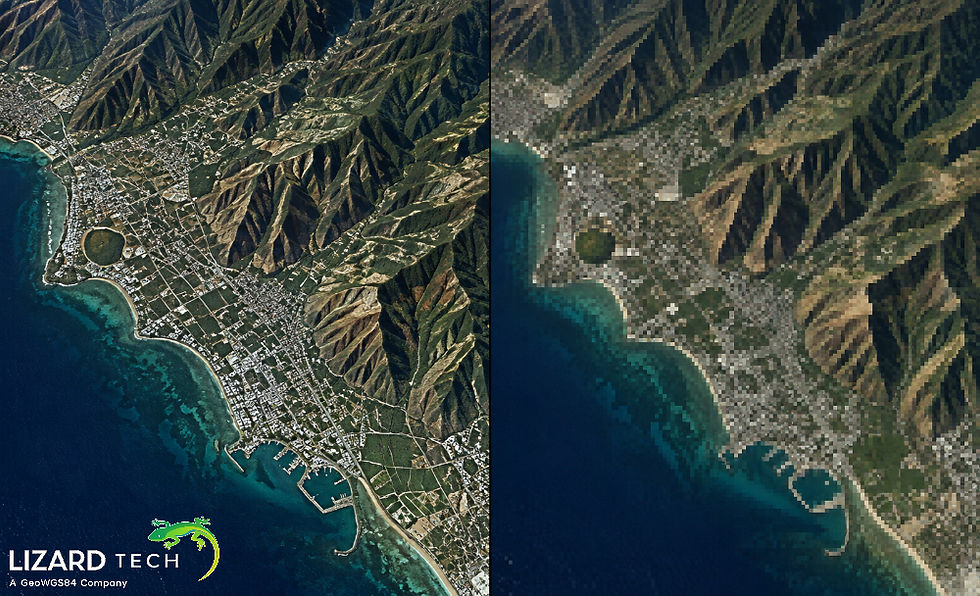
MrSID uses advanced wavelet-based compression to reduce image file sizes by up to 95% or more, while preserving critical visual detail.
Lowers the amount of storage space required for images
Permits faster transfer and sharing of data
Provides a higher degree of image fidelity for analysis
Multiresolution Access
One of the most powerful features of MrSID is the ability for the user to output from a single file to multiple resolutions of the same image.
User can view images at all zoom levels; no need to create separate pyramids or overviews.
Optimized for rapid display in GIS applications
Efficient Streaming and Viewing
MrSID allows for the ability of the user to select which portion of the image they would like to load.
Provides faster performance over low-bandwidth connections
Is well suited for web-based mapping and cloud environments
Reduces latency for large-scale deployments
Scalability for Enterprise Workflows
MrSID is designed to be completely integrated into existing geospatial infrastructures, from local cities to global corporations.
Compatible with all major GIS platforms
Can store huge amounts of images or enormous mosaic images and/or images encompassing at least a nation
Can be used efficiently for archiving and retrieval of images
Real-World Use Cases
Urban Development
Planners in urban areas may now utilize high-resolution data sets to enhance their abilities to analyze large images and make informed infrastructure choices.
Environmental Surveillance
Monitor areas that are experiencing deforestation, global warming, or changes to oceans with lightweight forms of electronic data storage.
Military Applications
Critical geospatial information is instantly accessible in the field and requires very little bandwidth.
Agricultural Systems
Using very high-frequency data sets, such as high-resolution photographs of crops and land uses, keeps storage systems from being overloaded with too much information.
MrSID vs. the Data Deluge
The scale of Earth observation will continue to grow, and the gap between data created and data usable will increase. As a result, organizations need to implement smarter ways of managing data to reduce the burden of using it.
Turning massive datasets into manageable assets
Enabling real-time access and analysis
Reducing infrastructure costs
Improving operational efficiency
The explosion of Earth observation (EO) data is both a blessing and a burden. Unlocking previously unknown insights about our planet and new data management methods are required as a result of this.
MrSID provides a tested, effective solution to help organizations compress, manage, and deliver large amounts of geospatial images without sacrificing quality or performance.
If your workflows have been adversely affected by data, consider changing your way of doing business - let MrSID handle the workload for you.
For more information or any questions regarding the LizardTech suite of products, please don't hesitate to contact us at:
Email: info@geowgs84.com
USA (HQ): (720) 702–4849
(A GeoWGS84 Corp Company)


Comments