

MrSID vs ECW: Best Geospatial Format for Large Raster Data

Updated: Aug 13
Selecting an appropriate compression scheme for large raster datasets, including satellite imagery, aerial photography, and scanned maps, is essential when working with huge datasets. There are two popular formats utilized in the geospatial field: MrSID (Multi-resolution Seamless Image Database) and ECW (Enhanced Compression Wavelet).
Even though both MrSID and ECW are effective for handling large images, they vary widely in performance, scalability, licensing, and long-term value. The objective of this article is to highlight the differences between the two formats and to explain why MrSID has remained the preferred selection for those involved with the management of large-scale geospatial imagery.

What Is MrSID?
MrSID is a wavelet-based raster compression format created specifically for geospatial imagery. MrSID allows for the compression of very large images down to only a small percentage of the original size, while maintaining high-quality visual fidelity and rapid access speeds.
Key Advantages of MrSID:
High-quality visual fidelity at large compression ratios and minimal loss of detail
Rapid accessed by utilizing multi-resolution as well as by enabling users to pan and zoom quickly and easily
Both storage and transmission of large amounts of raster data efficiently
Strong development support for creating valuable cell applications and for providing enterprise-level geospatial workflows.
What Does ECW Stand for?
ECW (Enhanced Compression for Windows) is a compression format like MrSID that uses wavelets for compressing aerial/satellite imagery. ECWs can display large image files without loss of quality and provide support for progressive rendering.
ECW Features:
Good Compression Ratio
Fast Rendering of Moderate-Sized Datasets
Major GIS Platforms Support
On the other hand, ECW has some limitations that become more impactful in Enterprise or large-scale applications.
MrSID vs ECW: Feature Comparison
Compression Efficiency
MrSID: Provides greater compression and maintains visual fidelity. Great options for large data sets; very important to save on storage space and bandwidth.
ECW: Good compression, but may take more hard disk space to achieve a similar visual quality to MrSID.
Scalability of Large Raster Data
MrSID is optimized for extreme scales (multi-gigapixel and much larger) and can handle large volumes of national geo-spatial image data.
ECW performs well with mid/large datasets but may not be able to operate at extreme scales as effectively.
Multi-Resolution Performance
MrSID provides true multi-resolution performance, with a pyramid-based structure for efficient retrieval of imagery and fast rendering, regardless of scale.
ECW provides progressive rendering, but image quality may degrade when used with very large datasets.
Image Quality
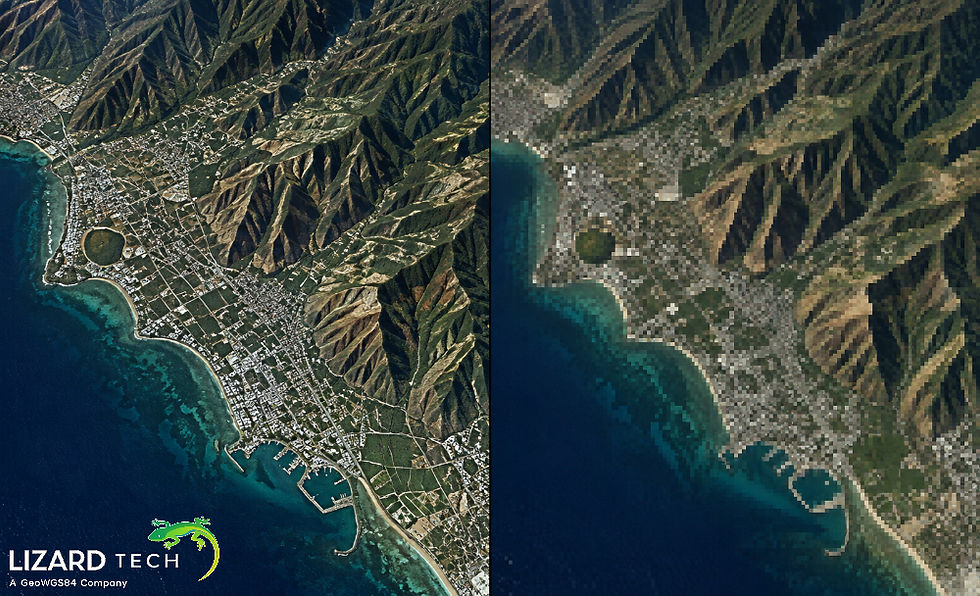
MrSID allows a high degree of visual fidelity even when the dataset is compressed aggressively.
ECW has good visual qualities but can display artifacts when the dataset is compressed at high compression ratios.
SDK and Developer Support
MrSID: Has a rich SDK that provides extensive integration options for both custom and enterprise solutions.
ECW: SDK access is limited and less versatile depending on your license type.
Licensing and Flexibility
MrSID: Has more flexible licensing options, particularly for organizations with large datasets.
ECW: Has restrictive licensing terms, particularly when it comes to encoding large volumes of imagery.
Why MrSID Is the Better Choice for Modern Geospatial Workflows
Modern geospatial data sets are becoming more and more complex; organizations require an image format designed to accommodate the mammoth size of today’s data without losing performance or quality. MrSID was specifically designed to handle this need.
Benefits of Using MrSID:
Easily process giga-pixel files of images.
Minimum storage space and bandwidth
Maximize product performance and efficiency for consumers.
Integrate with your enterprise GIS system easily.
The performance and efficiency that MrSID offers are what today’s GIS applications require, regardless of whether you are managing statewide orthophotos or international satellite images.
When Might ECW Still Be Used?
There are still some cases where ECW may work:
Small projects with an insufficient amount of data
Existing systems that were built using ECW workflows
Licensing restrictions on existing ECWs
For newer projects or growing data size, MrSID is the better, longer-term option.
Both MrSID and ECW are excellent geospatial imagery formats, but they are not the same when it comes to meeting today’s demands for data processing. MrSID consistently delivers better performance in terms of compression ratio, expandability, quality of processed image, and usability.
If your objective is to enhance storage efficiency and improve performance and create an infrastructure that can be reused for years to come, MrSID is obviously the best choice.
For more information or any questions regarding the LizardTech suite of products, please don't hesitate to contact us at:
Email: info@geowgs84.com
USA (HQ): (720) 702–4849
(A GeoWGS84 Corp Company)


Comments