

Advantages of MrSID over JPEG2000

Updated: Apr 21
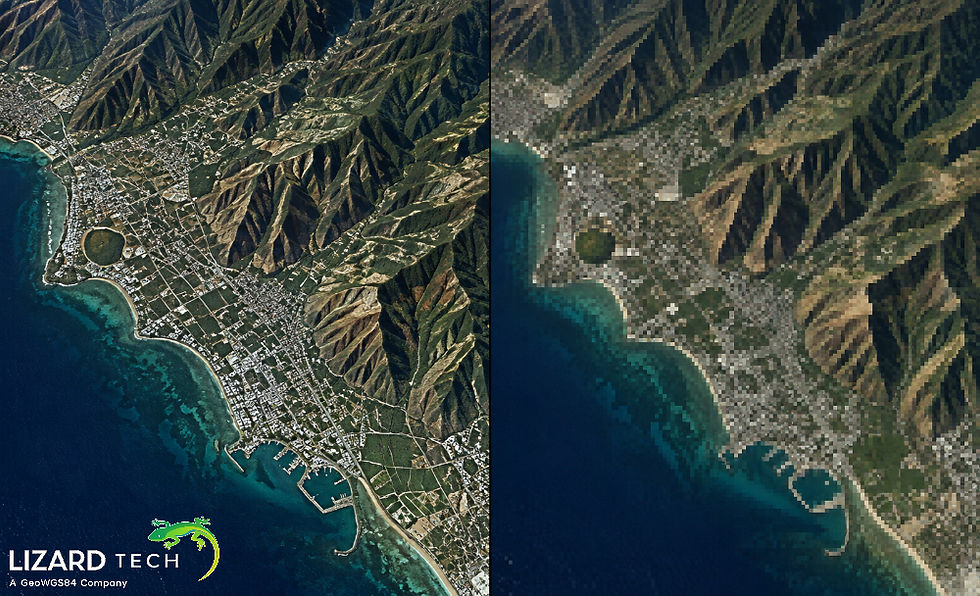
MrSID (Multi-resolution Seamless Image Database) and JPEG2000 are two different types of image compression formats; however the main difference between them can be found in their design. The design of MrSID is specifically tailored to handle large amounts of data, providing significant operational advantages to GIS workflows that utilize imagery.
Here are the primary reasons why MrSID is preferable to JPEG2000 for aerial/satellite imagery workflows.
Faster Rendering for Very Large Images
MrSID Advantage
Optimized for terabyte-scale imagery mosaics.
Uses multi-resolution pyramids embedded in the file.
GIS software can quickly access only the required resolution.
Result
Faster pan/zoom performance in GIS applications.
Lower CPU overhead when browsing massive imagery.
JPEG2000 can do resolution scaling, but decoding tends to be computationally heavier.
Superior Random Access for GIS
MrSID supports efficient tile-level access inside a single compressed file.
Benefits
Extract small image areas without decompressing the entire dataset.
Ideal for:
Web mapping
Streaming imagery
Large orthomosaics
JPEG2000 also supports region decoding, but MrSID’s indexing was tuned specifically for geospatial browsing.
Smaller File Sizes for Aerial/Satellite Imagery
In many geospatial benchmarks:
MrSID often achieves higher compression ratios with acceptable visual quality for natural imagery.
Typical production ratios:
MrSID: 20:1 – 50:1
JPEG2000: 10:1 – 30:1
This means:
Lower storage cost
Faster network transfer
(Actual results depend on encoder settings.)

Integrated Multi-Resolution (No External Overviews)
MrSID stores multiple resolution levels internally.
Advantages:
No separate pyramid files
No external .ovr or tile structures
Single portable file
JPEG2000 can store multiple resolutions but often requires more complex configuration to achieve the same workflow simplicity.
Optimized for GIS Streaming
MrSID was designed to support server-side streaming of imagery.
Benefits:
Efficient delivery of imagery tiles over networks
Reduced bandwidth requirements
Better performance for remote datasets
This is why many legacy imagery servers were optimized around MrSID streaming architectures.
Faster Encoding for Massive Orthomosaics
When compressing very large rasters (tens or hundreds of GB):
MrSID encoders historically provide:
Faster compression workflows
Lower memory usage
More stable processing of giant datasets
JPEG2000 encoding often requires:
More RAM
Longer processing times
Mature GIS Ecosystem
MrSID has deep integration in GIS platforms such as:
ArcGIS
Global Mapper
These platforms often include optimized MrSID readers.
Proven Production Use in Government Programs
MrSID has historically been used in large programs such as:
US state imagery repositories
National orthophoto programs
Statewide lidar/imagery portals
This resulted in very mature tooling for massive imagery archives.
Simpler Deployment
Typical MrSID workflow:
Huge GeoTIFF → MrSID → Single compressed file
Advantages:
No tile management
No multi-file pyramids
Easy distribution
Where JPEG2000 Is Stronger
To be objective, JPEG2000 has advantages too:
International open standard
Better lossless compression
More flexible metadata boxes
Wider support outside GIS
Feature | MrSID | JPEG2000 |
Large raster performance | Excellent | Good |
File size for aerial imagery | Often smaller | Good |
Streaming imagery | Very strong | Moderate |
Encoding speed | Faster | Slower |
Lossless compression | Good | Excellent |
Open standard | No | Yes |
For massive geospatial imagery (orthophotos, satellite mosaics, statewide datasets):
MrSID typically delivers faster visualization and smaller operational workflows.
For more information or any questions regarding the LizardTech suite of products, please don't hesitate to contact us at:
Email: info@geowgs84.com
USA (HQ): (720) 702–4849
(A GeoWGS84 Corp Company)


Comments