

Best Image Formats for Nationwide Aerial Mapping Programs

Updated: May 13
The aerial mapping programs across the country generate tremendous amounts of image data annually. Agencies at both the state and federal levels, as well as geospatial companies in the commercial sector, require image formats that efficiently store, manage, distribute, and analyze terabytes (or even petabytes) of raster image data with minimal degradation in quality or performance.
The choice of image format has a significant effect on costs of storage, processing speed, interoperability, and long-term access. GeoTIFF, JPEG 2000, Cloud Optimized GeoTIFF (COG), and MrSID are examples of image formats that currently play an important role in large-scale aerial mapping projects across the United States and are commonly used in geospatial workflows.

Why Image Formats Matter in Aerial Mapping
Modern Aerial Mapping Projects, such as:
Ultra high definition orthophotos.
Multi-spectral and hyper-spectral imagery.
LiDAR-Raster Products.
Rapid updates for disaster recovery and infrastructure planning.
Dissemination across the United States using cloud and web geospatial information systems (GIS).
As image resolution grows, the size of images will also significantly increase. For example, a county-sized orthomosaic may exceed 100 gigabytes; additionally, data throughout the country will be measured in petabytes.
An ideal image format would have:
Effective compression rates;
Rapid image streaming;
Multi-resolution availability;
GIS compatibility;
Ability to be archived for an extended period.
Ability to be delivered via cloud services at scale.
Unless all of these attributes are available through the format of the image, the cost of maintaining the necessary storage infrastructure will rise drastically, and delays will occur during image delivery.
Common Image Formats Used in Aerial Mapping
GeoTIFF
GeoTIFF is a popular format used in GIS and remote sensing.
Advantages
Widespread compatibility (with GIS software), embedded georeferencing metadata, simple and dependable format, industry standardised.
Disadvantages:
Large file sizes, slow web streaming performance, limited scalability of national datasets, and high-resolution imagery require a lot of storage.
Although GeoTIFF is a great format for analysis at the local level, it can become difficult to manage as more datasets are considered.
Cloud Optimized GeoTIFF (COG)
Cloud Optimized GeoTIFF extends the capabilities of GeoTIFF into the cloud.
Advantages:
Supports HTTP Range requests for streaming imagery, is better suited for web delivery, compatible with modern cloud-ready GIS systems, and has improved scalability over standalone GeoTIFFs.
Disadvantages:
COG will continue to be larger than Wavelet Compressed formats, resulting in higher costs of storage. In addition, if the mosaics are extremely large, the total performance of COG could diminish.
COG has become increasingly popular for storing imagery in cloud repositories; however, it will also require significant amounts of storage resources.
JPEG 2000
JPEG 2000 uses wavelet compression technology to achieve a significantly smaller file size while producing images that are visually similar or identical in quality to larger image sizes.
Advantages
High level of compression efficiency
Images can be progressively transmitted
All resolutions can be stored in one file
Can store images in both lossy and lossless formats
Limitations
Encoding and decoding time can be greater than normal in some workflows
Implementation is complicated
Different GIS platforms offer inconsistent support for JPEG 2000.
Although JPEG 2000 can provide substantial benefits in terms of a high level of compression, it can also create challenges with interoperability between GIS-based operational mapping systems.
Why MrSID is the premier choice for National Aerial mapping
MrSID was created with large geospatial image dataset storage and distribution in mind. MrSID is an ideal format for National Aerial mapping projects.
The original intent of creating MrSID was as a solution for storing and sharing large raster datasets that could be extremely difficult and costly to store and deliver; MrSID uses wavelet compression technologies to create files that can be significantly less than those of larger images without compromising the way people perceive them.
Benefits of MrSID
Unmatched Compression Ratios
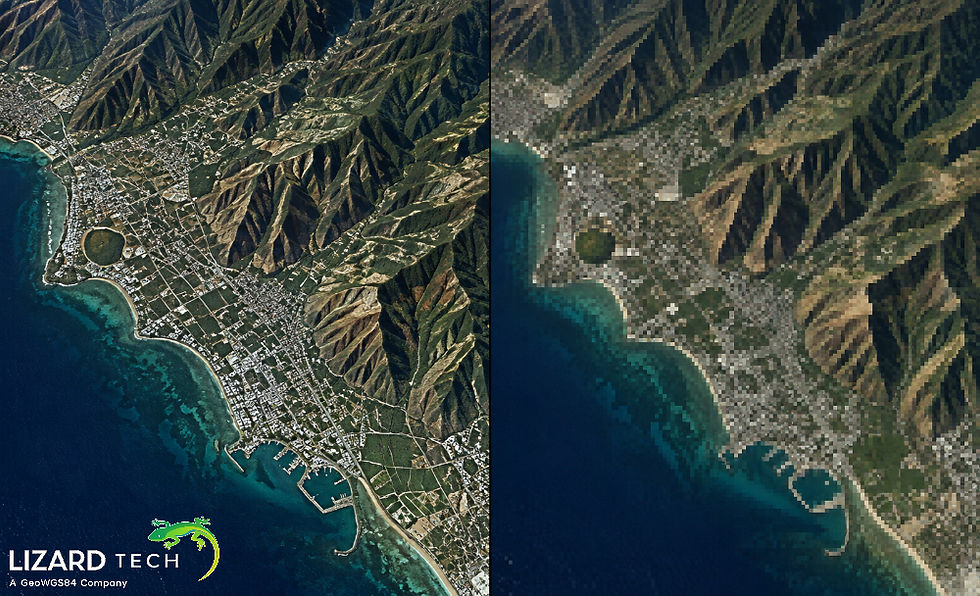
In many cases, MrSID files can be created that could reduce the size of aerial imagery files by 95% or more; however, they would still visually appear to have no difference when compared to an original image file. This can create a considerable reduction in infrastructure and archive storage costs for organizations that employ National programs using aerial imagery assets.
For example, if an organization has many thousands of orthophotography tiles to manage, the amount of storage savings achieved will be significant.
Multi-Resolution Image Access
MrSID collects multiple resolutions of digital imagery into one file, allowing users to easily zoom in/out without needing to load all levels of resolution for an image.
This benefits:
Web map performance
Enterprise GIS (Geographic Information System) responsiveness
Remote access using limited bandwidth
Large-scale visualization processes
Faster image streaming
Users can access only those portions of an entire data set that will be used for display or analysis instead of downloading entire data sets.
This is very helpful for:
Statewide orthophoto portables
Emergency response systems
Cloud-based imagery services
Mobile GIS applications
Efficient nationwide data distribution
Federal/state agencies, transportation departments, utility companies, and environmental organizations often need to distribute imagery from/to/within multiple contractors and locations.
Using MrSID will enable:
Faster transfer rates
Less bandwidth used
Easier data set sharing
Less complicated management of storage
Integration of Proven Enterprise GIS
With MrSID's interoperability (integration) with multiple enterprise GIS / remote sensing platforms, it can be integrated with your operational production systems.
MrSID users include:
ESRI ArcGIS
Remote Sensing Software
Geospatial Services
Custom Image Platforms
All of these can integrate MrSID into their current work processes efficiently.
MrSID vs Other Formats
Feature | GeoTIFF | COG | JPEG 2000 | MrSID |
Compression Efficiency | Moderate | Moderate | High | Very High |
Web Streaming | Limited | Good | Good | Excellent |
Multi-Resolution Support | Limited | Partial | Yes | Yes |
Storage Optimization | Moderate | Moderate | High | Excellent |
Enterprise Scalability | Moderate | Good | Good | Excellent |
Nationwide Mapping Suitability | Moderate | Good | Good | Excellent |
Best Use Cases for MrSID
The MrSID format is well-suited for the following applications:
National orthophoto repositories
State GIS imagery programs
Mapping of transportation corridors
Monitoring agricultural growth
Conducting environmental and forestry analyses
Managing emergencies
Archiving defense/intelligence imagery
Because MrSID can achieve a balance of compression, quality, and streaming performance, it is a preferred file format among organizations dealing with very large raster datasets.
The Future of Nationwide Aerial Imagery Management
Geospatial organizations are being challenged to enhance the storage and delivery of their imagery assets as aerial mapping and satellite data begin to grow through the expansion of drone programs, satellite constellations, and high-resolution aerial sensors.
Aerial mapping projects are looking for:
Higher streaming speeds
Reduced storage price
Ability to scale cloud storage
Access to real-time streaming
Enterprise-level performance
Integration of formats that allow for multiple resolutions and advanced compression will remain essential in evolving the geospatial infrastructure.
MrSID has proven to be a highly effective and Efficient format for organizations managing large volumes of aerial imagery over a regional and/or nationwide scale.
Choosing the appropriate format for images is one of the most important decisions that an organization will make related to a nationwide aerial mapping project. Through interoperability capabilities and strong support from cloud providers, GeoTIFF and COG provide a strong solution for agencies/organizations managing massive raster archives; however, many organizations are looking for more advanced features with respect to compression and streaming capabilities.
MrSID provides:
High compression efficiency
Faster image access
Savings on storage
Multi-resolution capabilities for images
Ability to scale to meet enterprise
For agencies or enterprises that manage large repositories of aerial imagery, MrSID continues to be one of the best formats for scalable geospatial data management.
For more information or any questions regarding the LizardTech suite of products, please don't hesitate to contact us at:
Email: info@geowgs84.com
USA (HQ): (720) 702–4849
(A GeoWGS84 Corp Company)


Comments