

Best GIS Image Format in 2026: Performance & Scalability

Updated: Aug 13
The amount of geospatial data available is increasing dramatically by the year 2026. With orthomosaics of whole states, nationally scanned elevation models, high-resolution satellite images, and drone images, GIS professionals require imagery formats that can deliver fast speeds, compression efficiency, and enterprise scalability, as well as maintain image quality.
Selecting an appropriate raster format is no longer a matter of simply selecting a storage medium. It directly impacts all performance aspects of GIS applications, not only at the desktop level but also when using cloud streaming, web services, and during long-term archival operations.

Why Image Format Matters in Modern GIS
Modern GIS workflows require:
Quick panning and zooming of terabytes worth of image files;
Efficient streaming from the Cloud or Internet;
Lossless or visually lossless compression options;
Support for large mosaic datasets;
Trustworthy metadata and accurate georeferenced locations;
Compatibility with ArcGIS®, QGIS®, and OGC® compliant data.
Choosing the correct format reduces your total cost to store, delays in rendering, and makes distribution easier. The right format helps speed up your entire Spatial Data Infrastructure.
Leading GIS Image Formats in 2026
Advantages
Commonly accepted and industry standard.
Allows georeferencing to be embedded within an image as part of the image's metadata.
Works natively in both ArcGIS Pro and QGIS
Can work with Cloud Optimized GeoTIFF (COG)
Disadvantages
Very large file sizes
Reduced performance when working with extremely large mosaics
Inefficient compression when compared to wavelet-based formats.
While GeoTIFF is still reliable, as datasets are increasing in size into the multi-terabyte range, performance bottlenecks will become increasingly obvious.
Most suitable for: High-quality visualisation and delivery of very large sets of imagery
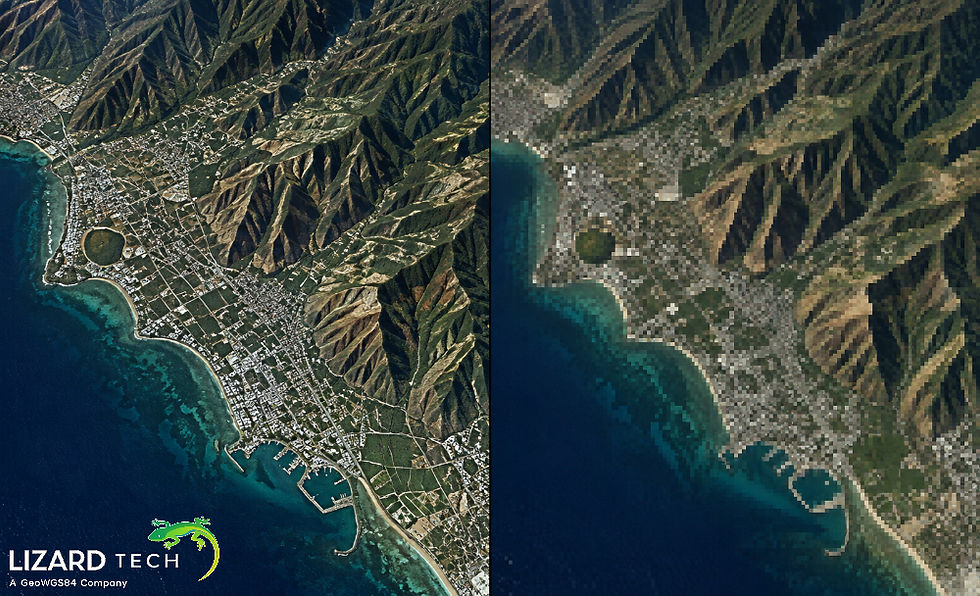
MrSID is a proprietary geospatial image format based on the MrSID (Multi-resolution Seamless Image Database) file structure.
Benefits:
Wavelet-based compression
Multi-resolution pyramids built into a single file
Extremely high compression ratios with minimal visual loss
Fast random access and progressive decoding
Optimized for massive aerial and satellite imagery
Performance Advantage
Unlike tiled TIFF formats, MrSID does not require storing multiple pyramid levels separately. It dynamically extracts resolution levels, improving:
Server streaming performance
Storage efficiency
User zoom responsiveness
Best Use Case: Large statewide or national imagery repositories where performance and scalability are mission-critical.
Cloud Optimized GeoTIFF (COG)
Cloud Optimized GeoTIFF (COG) is a more efficient way of storing geospatial raster data than standard TIFF. COG allows for easy retrieval via range requests over HTTP and cloud native access.
Strengths
Readily available for a cloud storage environment
Allows for efficient partial downloads
Becoming increasingly common in web GIS systems
Limitations
Still TIFF-based (i.e., moderate compression)
Takes up a larger amount of space on average than more modern wavelet formats
Large statewide/national mosaics will result in a slower performance.
Overall, while COG is the best option for accessing data from the cloud, it does not offer the same level of compression as other dedicated geospatial formats.
JPEG 2000 uses wavelet compression to store digital images and allows for multiple resolutions to be stored, therefore providing better image quality than both JPEG and TIFF.
Strengths
Wavelet-based compression means there is greater detail when retrieving images at high and low resolutions.
Accessing images at different resolutions is done progressively.
JPEG 2000 files are generally smaller than GeoTIFF files.
Limitations
May require longer to decode during some GIS workflows.
There are varied performance levels from enterprise to enterprise.
There is little optimization for geospatial datasets.
While JPEG 2000 has strong technical characteristics, the way it has been implemented can vary from enterprise to enterprise in terms of speed and quality of integration with other systems.
Performance Comparison (2026 Overview)
Feature. | GeoTIFF | COG | JPEG 2000 | MrSID |
Compression Efficiency | Moderate | Moderate | High | Very High |
File Size | Large | Large | Medium | Smallest |
Large Mosaic Performance | Moderate | Moderate | Variable | Excellent |
Cloud Compatibility | Growing | Strong | Moderate | Strong |
Enterprise Scalability | Limited | Moderate | Moderate | Best-in-Class |
GIS Optimization | General | General | Partial | Purpose-Built |
The 2026 Verdict: Performance & Scalability Victory
As geospatial data volume continues to increase, organizations should continue to focus on the following areas:
Storage efficiency
Fast rendering
Enterprise-grade scalability
Long-term cost control
While both GeoTIFF & COG are very supportive standards, MrSID has a design built specifically for optimal high-performing GIS.
For organizations that want maximum compression efficiency, seamless integration with GIS, and enterprise-based scalability, MrSID still leads in 2026.
Selecting an image format involves thoughtful deliberation. Increasingly high-resolution satellite images, expanding drone programs, plus AI-driven data analytics are generating ever-increasingly large datasets that require efficient data compression and ease of scalability.
If you're preparing for the upcoming age of geospatial analysis, you should evaluate MrSID as a possible primary raster image format, as that may result in better performance, increased space utilization, and improved return on investment over time.
For more information or any questions regarding the LizardTech suite of products, please don't hesitate to contact us at:
Email: info@geowgs84.com
USA (HQ): (720) 702–4849
(A GeoWGS84 Corp Company)


Comments