

How Image and LiDAR Compression Transform GIS Workflows
Updated: Apr 23
Data is the focus of contemporary GIS processes because they are data-centric workflows. Geographic professionals are expected to manage massive amounts of data, including satellite imagery at high resolutions as well as LiDAR point clouds that contain millions of points. The volume, complexity, and urgency of this data has never been greater; as a result, if you cannot efficiently manage large quantities of data, storage and performance will quickly become bottlenecks in your workflow.
With regard to how geospatial professionals manage their data, picture and LiDAR data compression technologies have played an influencing role through the newest generation of compression algorithms. Through these advanced compression technologies, the size of the compressed data file can be reduced, allowing for quicker access, improved sharing capabilities, and the ability to use scalable, enterprise-wide GIS processes. LizardTech’s MrSID® and GeoExpress® applications are proven solutions that can affect these transformations.

The Growing Challenge of Geospatial Big Data
Organizations using Geographic Information Systems or GIS face many of the same issues regardless of what industry they operate in. Here are some examples of those issues:
Massive datasets of LiDAR or images that tax data storage
Slow or difficult retrievals of data from those datasets via the Internet
Inability to distribute those datasets easily to multiple users or applications
High cost for storing that data long term overtime.
As sensor resolution and recording frequency will continue to increase, all these problems will only continue to get worse in the next decade. Compression becomes fundamentally necessary for organizations utilizing GIS to transform their business models moving forward into the next decade.
Why Compression Matters in GIS Workflows
Unlike the generic process of compressing files, geospatial compression requires preservation of the spatial accuracy of features, coordinate systems, and the metadata associated with a given geospatial feature. Delivering high-quality GIS compression will result in:
Smaller file sizes, while maintaining the same level of visual and analytical integrity
Faster streaming and rendering of large geospatial datasets.
Reduced storage and bandwidth costs.
Increased interoperability between GIS applications/technologies.
The means by which GIS datasets are compressed directly affect productivity across the entire GIS lifecycle, from data ingestion through to the analysis of the data, and finally to distributing the results of that analysis.
MrSID: Intelligent Image Compression for GIS
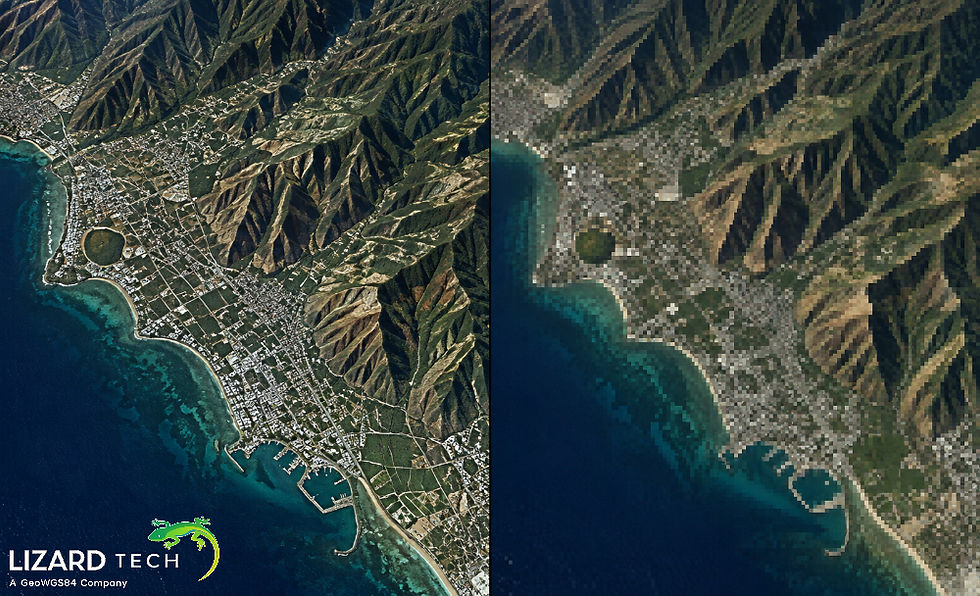
Multi-Resolution Seamless Image Database (MrSID) is a raster-based, wavelet compression format developed for geospatial imagery and has gained acceptance as a de-facto standard for storing and managing large raster datasets.
The MrSID file format has numerous advantages:
It offers very high levels of compression, producing an almost lossless file.
It provides the ability to access images at multiple resolutions, giving users the ability to view an image at any scale almost immediately.
It supports fast streaming of images over even low-bandwidth networks.
Geospatial information and metadata are embedded within each image file.
It also supports GIS tools including ArcGIS, QGIS, and a variety of web-based GIS services.
With MrSID, a GIS professional can easily access billions of bytes of imagery and utilize it in the same way as local files. This dramatically enhances performance and usability.
LiDAR Compression: Unlocking the Value of Point Clouds
Elevation modeling, infrastructure planning, forestry, flood mapping, and autonomous systems all rely heavily on LiDAR data; however, point clouds are very large. Advanced LiDAR Compression is a technique that allows organizations to:
Store & Manage Large Point Cloud Datasets Efficiently
Stream LiDAR Data for Real-Time Visualization & Analysis
Retain Accurate Elevation/Intense Values
Enable Scalable Enterprise-Wide Access
Compressed LiDAR data when combined with new GIS tools, enables analysts to concentrate more on gaining insights than worrying about limitations of their infrastructure.
GeoExpress: Powering Efficient Geospatial Data Pipelines
For processing, managing and preparing (for usage) raster and LiDAR datasets in an easy manner GIS application as well, GeoExpress® is LizardTech's case G optimal processing and exporting.
Why Use GeoExpress®?
MrSID image creation, optimized LiDAR datasets
Fine grain control over compression quality/performance
Batch processing capabilities for batch output of large quantity datasets for enterprise-scale production work flows
Integrated to your organization’s established GIS ecosystem
GeoExpress® is used as a necessary; essential, for pre-processing your data so that it is maximally utilized prior to going into any downstream systems storage, computing resources or time.
Transforming End-to-End GIS Workflows
The use of image and LiDAR compression benefits many areas of GIS, including:
Data Ingestion: Raw images and point clouds can be compressed right away to decrease the amount of space needed for the data.
Analysis and Visualization: Being able to access data at multiple resolutions allows for faster processing and more fluid interactions with users.
Collaboration and Distribution: Smaller files make it easier to share data with others inside or outside of an organization, including via a web service.
Archiving and Longevity: Compressed file formats keep the quality of the data while reducing the cost of long-term storage.
These benefits together create a GIS operation that is agile, scalable, and cost-efficient.
The Future of GIS Is Optimized Data
With GIS increasingly moving towards the cloud, using real-time analytics, and making use of Artificial Intelligence (AI), the need for good data management will become more important than ever before. Compression technologies, such as MrSID images and LiDAR using GeoExpress, are essential parts of that future.
In addition to providing a better way to perform work, compression transforms how we store, access and share geospatial data and opens up the full potential of the GIS.
For more information or any questions regarding the LizardTech suite of products, please don't hesitate to contact us at:
Email: info@geowgs84.com
USA (HQ): (720) 702–4849
(A GeoWGS84 Corp Company)


Comments