

MrSID vs GeoTIFF: Best Raster Format for GIS Data

Updated: Apr 22
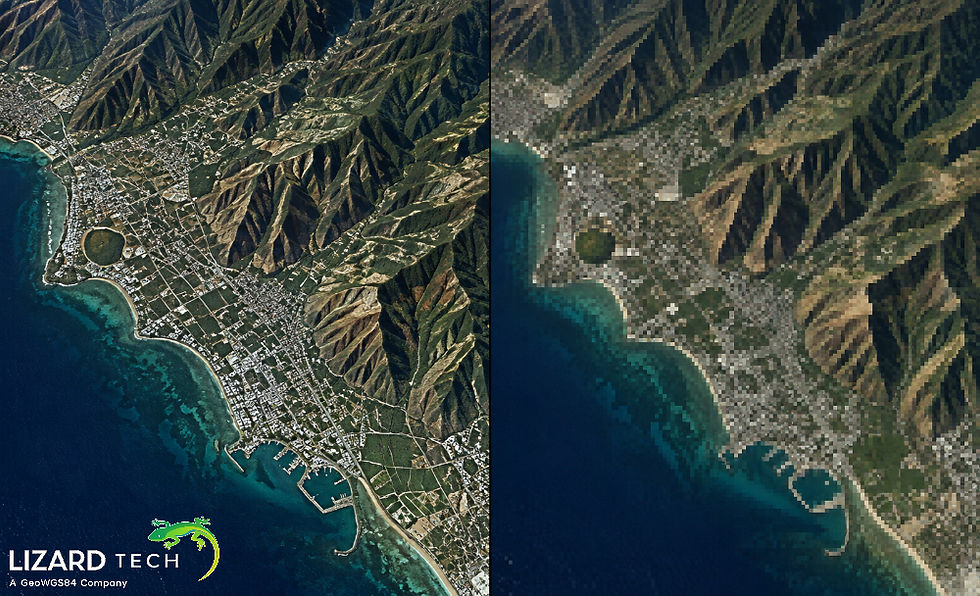
When using a Geographic Information System (GIS), your choice of raster format can affect performance, storage, and overall efficiency. MrSID and GeoTIFF are two popular raster formats. Each has its benefits, but MrSID will usually prevail as the best choice for high-resolution images and newer GIS workflows.

What is MrSID?
MrSID is a proprietary raster format created by LizardTech, specifically for the storage and streaming of high-performance, large imagery datasets. This makes it popular for GIS professionals who work with aerial photography and satellite imagery.
MrSID's Benefits:
Compression: Extremely efficient raster compression (up to 20:1) with virtually no loss in quality of the raster file.
Speed of Rendering: Supports selective tile loading, so even large datasets can be displayed in a GIS nearly instantaneously.
Web Mapping Optimized: Wonderful for online GIS applications where rendering speed and storage size can be a factor.
Multi-resolution: Allows for seamless zooming and panning of the image in the GIS and does not require loading the entire image into memory for the user experience.
What is GeoTIFF?
GeoTIFF is an open-standard raster format that embeds geographic metadata into the TIFF format, which is used frequently for archival storage and GIS analysis.
Pros of GeoTIFF:
Open Standard: Free and accessible to almost all software associated with GIS.
Supports complete metadata: Maintains storing georeferencing, coordinate system, and projection information.
Image Quality is Lossless: The exact pixel data is retained for precise analysis.
Great format for analysis: Great for classification, remote sensing, and spatial modeling.
Cons of GeoTIFF:
Large file sizes/ high resolution: High-resolution imagery can become very large, affecting the ability to store and process the image.
Slow rendering: Depending on the image, very noticeable when working with a large data set.
Storage Intensive: Stores large sizes, taking up potential space prohibitive for enterprise-level image archives.
MrSID vs GeoTIFF: Key Comparison
Feature | MrSID | GeoTIFF |
Compression | Superior (lossy & lossless) | Optional (mostly lossless) |
File Size | Compact | Very large |
Speed | Fastest for viewing & streaming | Moderate |
Editing | Limited | Fully supported |
Compatibility | Growing support, proprietary | Universal |
Licensing | Proprietary | Open-source |
Ideal Use Case | Web mapping, enterprise imagery | Analysis, archival |
Reasons MrSID Usually Comes Out on Top
GeoTIFF is a well-established standard, but MrSID is becoming a more popular choice for high-resolution, enterprise-level GIS projects. MrSID's compression efficiency, efficient rendering speed, and multi-resolution advantages lead to an overall workflow advantage that GeoTIFF cannot offer when working with massive datasets. Given the large datasets sometimes encountered in GIS (on the order of terabytes), MrSID's small file footprint and streaming performance are a better choice.
Performance Benefits: It will reduce loading times and make GIS software more responsive.
Storage Savings: It will reduce storage needs significantly without affecting image clarity/quality.
Future Proof for Web GIS: MrSID is optimized for online mapping and cloud GIS needs.
If you are a GIS professional who works with mass imagery data, MrSID is the clear winner. Although GeoTIFF is a great choice for archival and analytical reasons, MrSID is more effective and offers advantages, including speed and user experience. Overall, MrSID is the perfect image format for today's GIS.
For more information or any questions regarding the LizardTech suite of products, please don't hesitate to contact us at:
Email: info@geowgs84.com
USA (HQ): (720) 702–4849
(A GeoWGS84 Corp Company)


Comments