

Running Out of Rack Space? How GIS Tools Cut Data Congestion

Updated: Aug 14
Data centers are under constant pressure to do more with less—more data, more users, more performance—yet with the same physical footprint. One of the biggest challenges infrastructure teams face today is rack space congestion, driven by explosive growth in geospatial data such as satellite imagery, aerial photography, and LiDAR datasets.
.
If your organization works with GIS data, you already know: these files are massive, complex, and expensive to store and manage. The good news? There’s a smarter way to handle it—without expanding your data center.
Let’s explore how advanced geospatial compression tools like GeoExpress and the MrSID format can dramatically reduce storage demands and eliminate rack space bottlenecks.

The Root of the Problem: GIS Data Growth
A high-definition digital image with geographic information is crucial in many different sectors and disciplines, including:
Defense & Intelligence
City Planning
Environmental Monitoring
Utilities & Infrastructure
Agriculture
However, these datasets require many resources to store:
Massive amounts of data (usually ranging from tens to hundreds of GB per picture)
Multiple copies/versions of data (for backup and for workflow purposes)
Slow transfer speeds of data
Large amounts of hardware are necessary to work with the data.
Thus, data centers will quickly reach capacity and will require either a costly increase in physical capacity and/or an inefficient way to work around these capacity limitations.
Why Traditional Storage Scaling Fails
When a team runs into storage limitations, the knee-jerk reaction tends to be:
Expanding your number of servers
Adding to your storage array (increased capacity)
Moving your data to an external/cloud provider
The long-term impacts of these options are:
Increased capital and Opex costs
Complexity in infrastructure management
Performance bottlenecks when moving data
Simply scaling storage will not eventually resolve the problem; rather, you need to reduce the size of the data footprint on the existing infrastructure.
Enter GeoExpress: Intelligent Compression for GIS Data
GeoExpress is engineered to resolve issues related to how to store geospatial data.
Major Characteristics:
Extremely High Compression Ratios
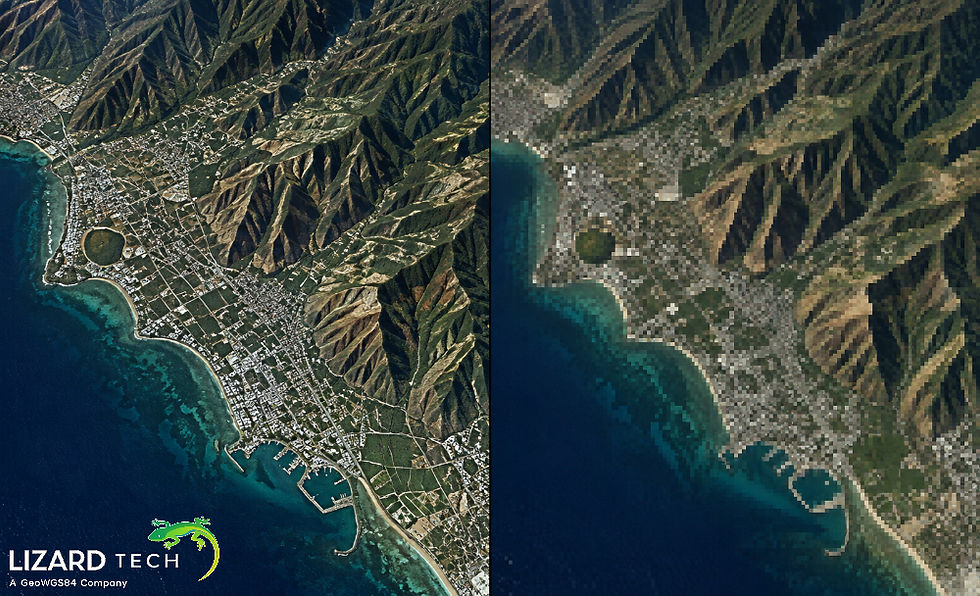
GeoExpress will allow you to compress raster images using compression ratios as high as 20:1 (or greater), which reduces the size of the raster image file while maintaining the same image quality.
Lossless versus Visually Lossless
You can select your compression method of choice:
Lossless compression for data integrity
Visually lossless compression for maximum storage efficiency
Batch Processing at Scale
GeoExpress makes it easy to automate the process of compressing your data on a large scale, making it an ideal tool for organizations with large amounts of geospatial data.
Improved Data Access
Smaller raster image files will produce faster read/write speeds and provide improved performance within your applications.
The Power Behind It: MrSID Format
At the core of GeoExpress is the MrSID format.
Why MrSID Matters:
Multi-resolution architecture: Access only the resolution you need, reducing processing load
Efficient streaming: Faster data delivery across networks
High-quality compression: Maintain visual fidelity even at high compression ratios
Wide compatibility: Supported by major GIS platforms
This means you’re not just compressing files—you’re optimizing how data is stored, accessed, and used.
How This Solves Rack Space Congestion
Let’s break it down:
Challenge | Traditional Approach | GeoExpress + MrSID Solution |
Large file sizes | Add more storage | Compress data by up to 95% |
Rack space limits | Expand data center | Reduce storage footprint |
Slow data transfer | Upgrade bandwidth | Smaller files transfer faster. |
High costs | Invest in hardware | Optimize existing infrastructure |
Real-World Impact
Organisations using MrSID and GeoExpress have seen:
Storage savings of as much as 80% to 95%
Quicker performance for GIS applications
Lower infrastructure costs
Improved data sharing between teams
In data centres, this means:
Fewer servers
Less power/ cooling needs
Better use of rack space
Best Practices for Implementation
To get the most from these benefits:
Identify Your High-Volume Datasets
Target large raster images and archives that take up the most storage.
Use the Right Compression Type
Use lossless compression for critical datasets.
Use visually lossless compression for everything else (general use and analysis)
Automate Workflows
Utilise GeoExpress batch processing for ongoing data ingestion.
Integrate with Existing GIS Systems
Ensure that it will work well within your GIS system (like ArcGIS, QGIS, etc.).
Future-Proof Your Data Center
The continued growth of geospatial data requires smarter—not larger—solutions.
By installing GeoExpress and utilising the productivity gains of MrSID, you can:
Eliminate the constraints of your racks.
Lower infrastructure costs
Enhance performance and scalability.
Running out of rack space isn’t just a hardware problem—it’s a data optimization problem.
Instead of expanding your data center, consider transforming how your data is stored. With the right GIS compression strategy, you can unlock significant savings, streamline operations, and stay ahead of growing data demands.
For more information or any questions regarding the LizardTech suite of products, please don't hesitate to contact us at:
Email: info@geowgs84.com
USA (HQ): (720) 702–4849
(A GeoWGS84 Corp Company)


Comments