

Why State DOTs Rely on MrSID for Geospatial Compression

Updated: Aug 15
Many state departments of transportation (DOTs) oversee some of the largest and most complicated sets of geospatial data in government. With orthophoto and LiDAR imagery statewide, engineering drawings, and corridor data, DOTs are still storing and managing increasing volumes of images and raster data each year.
To save space and handle large amounts of data, most departments of transportation (DOTs) use a very powerful geospatial compression format called MrSID (Multiresolution Seamless Image Database), which is specifically designed for large-scale imagery.

The Growing Challenge of Statewide Geospatial Data
Modern transportation agencies depend on high-resolution imagery and elevation data for:
Highway planning and design
Bridge inspection and asset management
Environmental analysis
Right-of-way management
Disaster response and recovery
Infrastructure modernization initiatives
A single statewide aerial imagery program can easily generate terabytes of data. LiDAR collections often exceed that. Without efficient compression and intelligent data handling, storage costs, network performance, and system responsiveness quickly become limiting factors.
DOTs need a solution that:
Reduces storage requirements
Preserves image quality
Enables fast access and streaming
Integrates with existing GIS systems
Supports long-term archival
This is where MrSID excels.
What Is MrSID?
MrSID is a high-performance raster compression format engineered specifically for geospatial imagery. Unlike generic image compression formats, MrSID is optimized for:
Massive orthophotos
Scanned maps
Large engineering drawings
Elevation and terrain models
Its wavelet-based compression technology enables significant file size reduction while maintaining visual and analytical integrity.
Key Reasons DOTs Choose MrSID
Excellent compression ratios without sacrificing quality
DOTs use MrSID primarily due to how well it compresses images with high compression ratios, maintaining detail.
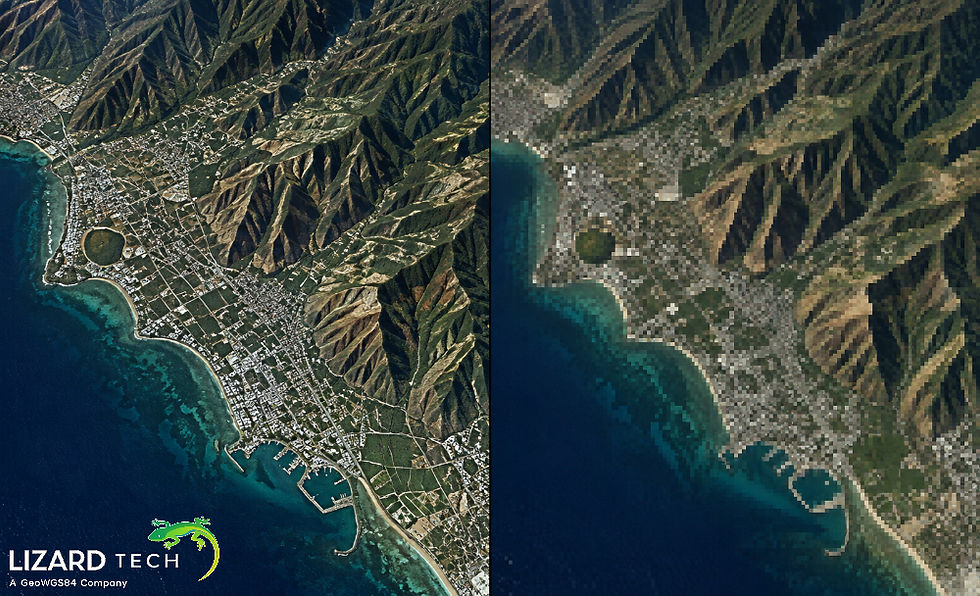
For instance, a statewide orthoimage mosaic could be several terabytes in size as uncompressed TIFF files, but can be compressed considerably smaller with MrSID. This reduced size creates significant efficiency gains for both storage and retrieval.
DOTs that have to operate under tight IT budgets realize a significant financial benefit by being able to reduce the costs related to their storage infrastructure.
Quick Access, Multi-Resolution
MrSID's multiresolution structure allows users to quickly get just the portion of an image they are interested in and the appropriate resolution.
Instead of needing to load up an entire statewide dataset, GIS users can:
Zoom into a specific corridor.
Get a county-level overview.
Obtain just the project area of interest.
This ability for users to access data in a selective manner provides significantly better performance for GIS users across enterprise GIS applications.
For DOTs delivering imagery to various internal divisions or to the public via web portals, the efficiency of MrSID is essential.
Optimized for Enterprise GIS and Web Delivery
Transportation agencies rely on enterprise GIS environments such as:
ArcGIS
Custom web GIS platforms
Asset management systems
MrSID integrates seamlessly into these workflows, supporting:
Server-based image streaming
Multi-user environments
Web-based visualization
Distributed teams
This makes it easier for planning, engineering, and maintenance teams to access the same authoritative imagery source without duplicating datasets.
Reduced Network Bandwidth Usage
State DOTs often operate across multiple district offices. Transferring large imagery files between locations can strain network infrastructure.
Because MrSID delivers imagery progressively and selectively, it significantly reduces bandwidth consumption. Users retrieve only the image portions necessary for their task, minimizing unnecessary data transfer.
This improves responsiveness for:
Remote offices
Field operations
Mobile GIS users
Scalable Statewide Imagery Management
The DOT has many more imagery programs than I listed above. Many agencies acquire updated orthophotography and LiDAR every few years.
MrSID is great because it supports:
Large mosaics where the entire state is covered
Long-term strategies for archiving
Versioned datasets
Multi-year worth of imagery available
The fact that MrSID is scalable means that your agency can create a structured, sustainable geospatial repository that expands as the geographic or infrastructure requirements change.
Long-Term Reliability and Trust in the Industry
Many state transportation agencies have been using MrSID for many years. The stability, backward-compatible way MrSID was developed, and the amount of usage of MrSID over a long period of time are good reasons to choose MrSID to manage your data for a long time.
In the public infrastructure world, long-term access to imagery is essential to agencies. They need to ensure that they maintain a way to access the imagery they have, regardless of changes in technology or in the agency’s GIS system.
With the number of successful deployments of MrSID throughout the years, you can be confident that using MrSID for long-term data management is a good decision.
Use Cases: How DOTs Leverage MrSID
Statewide Orthophoto Distribution
State DOTs can efficiently compress and distribute their annual or biennial orthophoto collection(s) to both internal and external users.
Transportation Corridor Analysis
Engineers are able to access high-resolution imagery for transportation corridors only by accessing the imagery for the specific routes in which they are working, rather than copying down the entire state data set.
Bridge and Asset Management
Field inspectors can quickly retrieve imagery for specific structures through the GIS portals that are accessible to them.
Emergency Response
During natural disasters such as flooding, severe storms, or infrastructure failures, agencies at the state level are able to quickly access and share their orthophotography information among all agencies or departments in the state.
State Departments of Transportation operate at a statewide scale. Their geospatial data must be:
Accurate
Accessible
Efficient
Scalable
Sustainable
MrSID delivers the compression performance, multiresolution access, and enterprise integration required to support modern transportation infrastructure management.
For DOTs tasked with managing massive imagery libraries and delivering reliable data across agencies, MrSID remains a trusted and proven solution.
For more information or any questions regarding the LizardTech suite of products, please don't hesitate to contact us at:
Email: info@geowgs84.com
USA (HQ): (720) 702–4849
(A GeoWGS84 Corp Company)


Comments