

Advanced Raster Compression Software for Geospatial Data

Updated: Aug 13
High-resolution geospatial images are critical for today's mapping, military applications, city planning, agricultural use, environmental monitoring, and other applications. From satellites to drones and from photographs to laser scans (LiDAR), they make up the building blocks of modern mapping. As the resolution of these images increases, the size of the files increases as well (file size), resulting in increased costs (storage cost) and more problems associated with transmitting data (data transfer).

How much geospatial raster data is generated per day by modern Earth observation constellations and UAV fleets?
Currently, global satellite, aerial, and drone platforms generate roughly 200–1,200 terabytes per day, equivalent to approximately 0.2–1.2 petabytes daily, with volumes steadily increasing as constellations and UAV operations expand.
Source | Daily Volume (Estimate) |
Satellites | 100–1,000 TB |
Aerial | 10–50 TB |
Drones | 50–200 TB |
TOTAL | ~200 TB to 1.2+ Petabytes per day |
*Estimated figures generated by ChatGPT
By 2030, global satellite, aerial, and drone imagery generation is projected to grow 3–5×, potentially exceeding 3–5 petabytes per day due to expanding constellations, higher-resolution sensors, and scaled UAV operations.
The Challenge of High-Resolution Geospatial Data
Every day, geospatial workflows produce:
30 cm - 1 m satellite images
<10 cm aerial photos
High-density multispectral and hyperspectral raster datasets
Time series images for analytical purposes
A single orthomosaic can exceed 100gb, and statewide or even nationwide datasets can reach terabyte levels.
The biggest issues are:
Storage constraints
Slow-moving data on the network
Not an effective use of Web visualization
GIS application processing bottlenecks
Costly archiving and long-term preservation
None of the above issues are resolved unless advanced compression is utilized - each will directly impact operational efficiency/costs.
What Is Advanced Raster Image Compression?
Raster compression decreases file weight without sacrificing the image's visual quality or spatial reference information. Compared to traditional image compression methods (e.g., JPEG or PNG), geospatial compression must maintain:
Coordinate Reference Systems (CRS)
Georeferencing information
Multiband integrity
Radiometric accuracy
Quickly accessing random areas of an image.
Typical features of advanced raster compression software include:
Lossless Compression – maintains exact pixel values.
Visually Lossless Compression – greatly reduces file size while having very little visible difference in quality.
Wavelet based Compression allows for multi-resolution access.
Tiling and Pyramiding – allow for rapid rendering and streaming.
Why Wavelet-Based Compression Matters
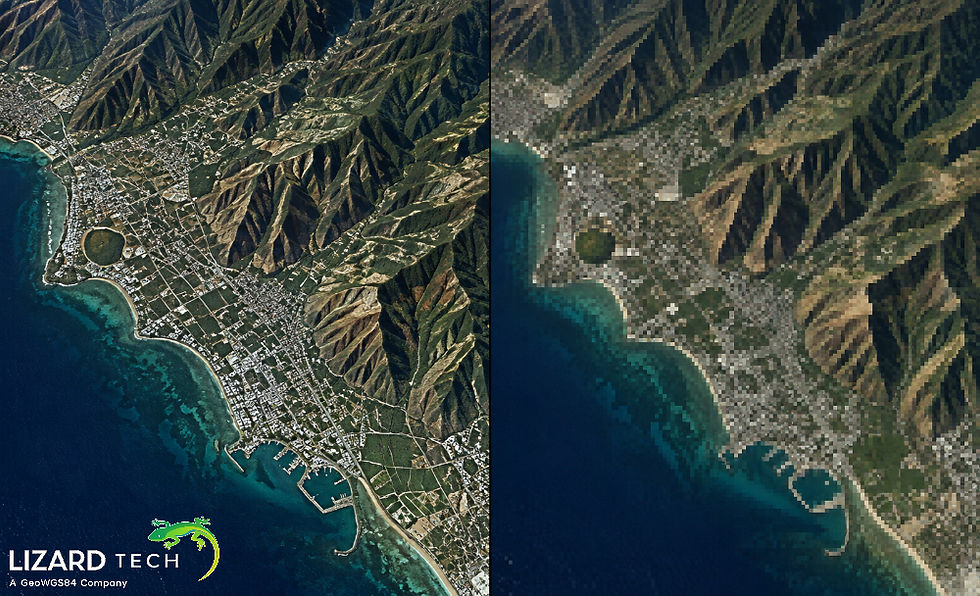
Compression techniques using DCT methods (such as JPEG) aren't able to compress very large image files effectively and create "blocking" visuals in the process. Instead, current geospatial systems use wavelet compression techniques, which provide:
The ability to incrementally decode images from low resolution through full resolution
The ability to efficiently zoom and pan the image
The ability to store multiple resolution images in one file
The ability to achieve high compression rates with excellent visual quality
The MrSID file format developed by LizardTech is based on this technology.
LizardTech’s Raster Compression Technology
MrSID – Multi-resolution Seamless Image Database
MrSID is a wavelet-based raster format specifically engineered for large geospatial imagery.
Key Technical Advantages:
Multi-resolution image pyramids stored in a single file
High compression ratios (10:1 to 50:1 depending on use case)
Fast region-of-interest (ROI) access
Metadata preservation
Industry-wide GIS compatibility
MrSID allows users to view massive images without loading the entire dataset into memory—critical for enterprise GIS deployments.
Ideal For:
Statewide aerial imagery archives
Satellite imagery distribution
Defense and intelligence workflows
Web-based geospatial applications
GeoExpress (Enterprise Class Raster Processing and Compression Tool)
GeoExpress is the powerful desktop application from LizardTech that enables GIS professionals to compress, mosaic, reproject, and manage raster datasets.
The core capabilities of GeoExpress include:
Converting large TIFF, JPEG2000, NITF, and other formats to MrSID
Batch Compression of Enterprise-Size Datasets
Reprojecting and Color Balancing of Images
Mosaicking & Tiling
Supports both Lossless and Lossy Compression Options
Using GeoExpress allows GeoSpatial Teams to:
Reduce Storage Infrastructure Costs
Speed Up Data Distribution
Standardize Their Imagery Archives
Enhance GIS Performance
Performance Benefits of Advanced Raster Compression
By using advanced raster image compression solutions, you'll see a return on investment (ROI) in measurable ways:
Storage Cost Reduction
Image compression can create files that are 90% smaller than the original file size-and thereforereduce your storage costs on both your desktops and in the Cloud.
Faster Transmission of Data
When you use compressed images to transfer data over the WAN and Internet, you will greatly reduce the time it takes to transfer files. This is essential to remote users and field operations.
Increased Performance of GIS Applications
Using multi-resolution and tiled building structures for images in GIS applications will give you the following advantages:
Fast rendering
Efficient zooming
Reduced RAM usage
Improved Web Mapping Performance
Using compressed raster formats will improve performance when using:
Web GIS portals
Internet-based mapping services
Streaming platforms
Best Practices for High-Resolution Raster Compression
To maximize efficiency:
Define use case (analysis vs visualization)
Select an appropriate compression ratio.
Maintain consistent CRS and metadata.
Use batch processing tools like GeoExpress.
Implement enterprise storage strategy.
Why Choose LizardTech for Raster Image Compression?
With decades of expertise in geospatial imaging, LizardTech delivers:
Proven wavelet compression technology
Enterprise-grade performance
Trusted adoption across government and defense sectors
Reliable support for large-scale deployments
By leveraging MrSID and GeoExpress, organizations can transform massive geospatial imagery into efficient, accessible, and scalable datasets.
The increase in the size and complexity of geospatial data means that advanced raster image compression is essential for all organizations as they build the foundation of their geospatial infrastructure.
LizardTech’s MrSID and GeoExpress solutions provide all of the speed, scalability, and dependability necessary to manage an enterprise-level library of geospatial images and data.
Your business can reduce the total cost of ownership, improve the performance of measurement and analysis, and speed up decision-making significantly through the implementation of advanced raster image compression technology.
For more information or any questions regarding the LizardTech suite of products, please don't hesitate to contact us at:
Email: info@geowgs84.com
USA (HQ): (720) 702–4849
(A GeoWGS84 Corp Company)

Comments