

What Is MrSID Compression? GIS Image Compression Explained

Updated: Aug 14
MrSID is a specialized compression format designed for high-resolution imagery and visual data, widely adopted across the geospatial and GIS industries. Despite its name, MrSID is not a person; it is an acronym for Multi-Resolution Seamless Image Database, reflecting its ability to efficiently store and deliver massive raster images at multiple resolutions.
The original prototype of MrSID compression technology was developed at Los Alamos National Laboratory in 1992. Building on this research, LizardTech later commercialized the technology with the release of MrSID Generation 2 (MG2) in 1998. This version introduced advanced wavelet-based compression optimized for large geospatial datasets.
Over time, LizardTech continued to enhance the MrSID format, focusing on improved compression efficiency, faster data access, and expanded GIS functionality. The most advanced version of the format, MrSID Generation 4 (MG4), was officially introduced in 2009, offering higher performance, improved image quality, and better support for large-scale geospatial workflows.

What is a SID file?
A SID file is a raster data format created using MrSID (Multi-Resolution Seamless Image Database) compression, designed to efficiently store and display large-scale imagery and geospatial data. SID files are widely used in GIS, remote sensing, and mapping applications where performance, image fidelity, and storage efficiency are critical.
Compression Capabilities
SID files can be generated from a wide range of raster and point cloud formats, including GeoTIFF, ERDAS IMAGINE (IMG), ECW, and LAS LiDAR files. Although SID files are compressed, they preserve the visual quality and fine detail of the original imagery or data.
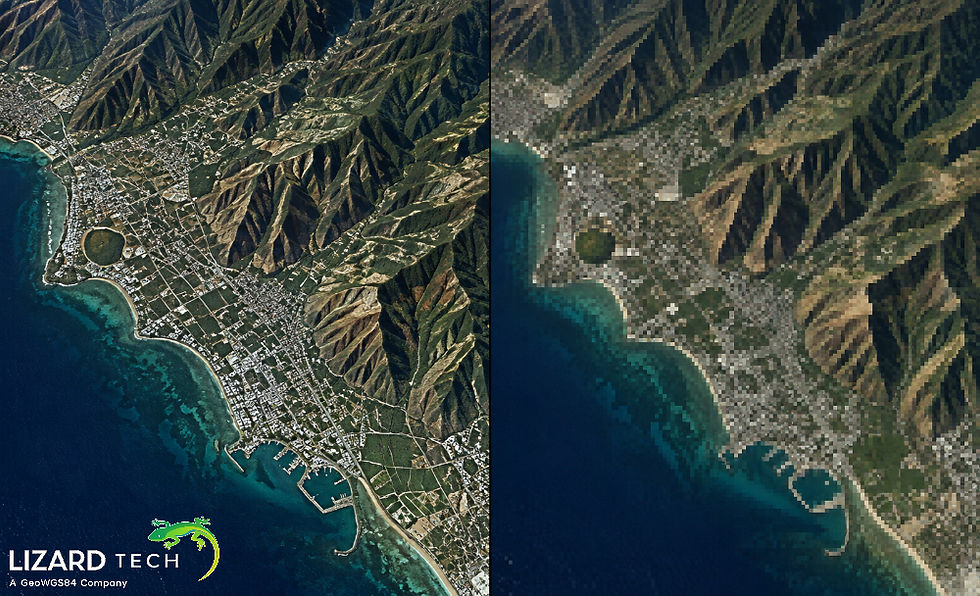
MrSID supports both lossless and lossy compression modes. In lossless mode, all original data values are preserved exactly. In lossy mode, MrSID employs an advanced wavelet-based compression algorithm that maintains exceptional image quality even at very high compression ratios. This allows users to create visually lossless images that are only a fraction of the original file size, without the artifacts commonly associated with traditional lossy compression techniques.
As a result, SID files offer the advantages of compressed data—such as easier sharing, faster transfer, and reduced storage requirements—without sacrificing image integrity.
High-Performance Viewing and Access
One of the most powerful features of SID files is their optimized viewing performance. When imagery is encoded in MrSID format, it is stored internally as multiple resolution levels within a single file. This approach is similar to image pyramid structures, but without creating separate files or incurring additional storage overhead.
All resolution levels are inherently embedded in the MrSID encoding. When a SID file is viewed, the application decodes only the resolution level required at that moment, enabling fast zooming and panning even with extremely large datasets.
In addition to multi-resolution access, MrSID technology supports selective decompression. This allows applications to decode and display only the geographic area of interest rather than the entire image. By contrast, many traditional raster formats require full-image decompression even when only a small portion of the data is needed.
What makes MrSID imagery so valuable?
How Do You Open a SID File?
MrSID is widely supported across the geospatial software ecosystem through Extensis integration partnerships. Many leading GIS and remote sensing applications can natively read SID files, including Esri ArcGIS, ERDAS IMAGINE, ENVI, and Autodesk products.
Support for the SID file format continues to expand as Extensis makes its MrSID Decode Software Development Kits (Decode SDKs) publicly available. These SDKs enable software developers to integrate MrSID decoding capabilities into their own applications, allowing virtually any GIS or imaging platform to open and display SID files efficiently.
How Do You Create a SID File?
MrSID technology is largely input-format agnostic, allowing SID files to be created from a wide range of industry-standard raster formats, provided they meet the required data type specifications. Common source formats include GeoTIFF, ERDAS IMAGINE (IMG), and ECW.
New SID files can be generated using tools such as GeoExpress and Portfolio, which provide advanced controls for compression type (lossy or lossless), resolution management, and output optimization. These tools enable organizations to efficiently convert large imagery datasets into the MrSID format while preserving image quality and spatial accuracy.
Industries That Use the MrSID File Format
MrSID files are used across numerous industries that depend on high-resolution imagery and geospatial data, including:
Civil engineering and infrastructure planning
Energy industries, including oil and gas, renewable energy (wind and solar), and utilities
Utility companies and asset management
National security and defense
Public safety and emergency response
National archives and government record management
Libraries and digital preservation initiatives
Art museums and cultural heritage institutions
Commercial drone imagery operations
Recreational drone imagery and mapping applications
As more industries require efficient methods for ingesting, editing, sharing, streaming, and visualizing high-definition imagery, the MrSID file format continues to gain adoption due to its exceptional compression efficiency, performance, and scalability.
Common Use Cases for MrSID Compression
MrSID is widely adopted in:
Satellite and aerial imagery distribution
Government and defense mapping systems
Environmental monitoring
Urban planning and land management
Web-based map services
MrSID vs Other Raster Compression Formats
Feature | MrSID | GeoTIFF | JPEG2000 |
Compression Type | Wavelet | Optional | Wavelet |
Multi-Resolution | Native | Limited | Native |
Spatial Indexing | Yes | No | Limited |
Large Image Handling | Excellent | Moderate | Good |
Streaming Performance | Excellent | Poor | Good |
MrSID is often preferred when performance, scalability, and interactive access are critical.
MrSID's raster compression capabilities are optimized for maximizing compression ratios, structurally organizing multi-resolution images for ease of access, and enabling users to quickly stream images into their applications.
For many companies that work extensively with large raster data sets, MrSID has proven to be one of the best and most efficient compression options available today.
For more information or any questions regarding the LizardTech suite of products, please don't hesitate to contact us at:
Email: info@geowgs84.com
USA (HQ): (720) 702–4849
(A GeoWGS84 Corp Company)


Bài viết của bạn viết gọn mà rõ, đọc một mạch là hiểu ngay, cảm ơn vì đã chia sẻ nhé. Mình cũng hay xem thống kê XSMB mỗi ngày, nhưng trước đây phải mở nhiều chỗ để đối chiếu nên khá tốn công. Sau đó mình tự tổng hợp lại cho dễ theo dõi, kiểu lưu về một trang trên soicau247.com để lúc cần thì xem lại nhanh hơn. Thỉnh thoảng mình chỉ muốn nhìn số liệu cập nhật theo ngày thôi, không cần gì phức tạp. Nếu bạn cũng có thói quen kiểm tra thường xuyên thì có thể tham khảo thêm ở đây: https://soicau247.com/bi-kip-choi-song-thu-lo-kep-bat-bai-tu-cac-cao-thu-d817.html.